[ad_1]
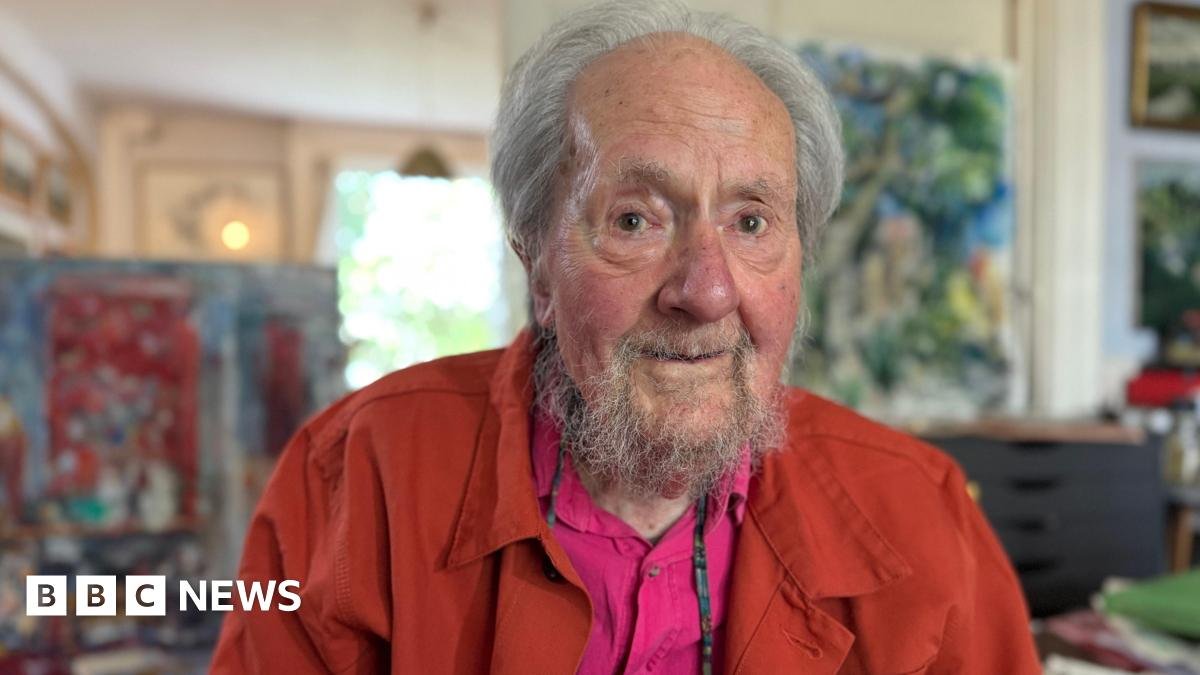
Jackie Reeves stands in front of Contingency Plan, a drawing (or is it a painting?) in her current exhibition, “Larger Than Life,” at the Provincetown Art Association and Museum. “It refers back to my childhood growing up with architect parents,” she says. The image is dominated by a black-and-blue splatter of paint at the center of the composition. In the bottom left corner, a young woman crouches sketching a line, part of a drawing that circles the composition, articulating walls, stairways, and rooms out of the painterly mess.

As a child, Reeves was fascinated by the scale models lying around her house. Her parents met studying architecture at McGill University in Montreal. They had seven children, and her mother’s career was “put on the back burner or off the stove entirely,” she says. Yet her mother did build architectural models at home.
“She was very mathematical and super precise,” says Reeves. “I have memories of her working with mini trees and little people and buildings with glass windows.”
The models became objects for Reeves to play with, like dollhouses, but they also served as examples of a creative process. She reflects on this in Contingency Plan, which speaks to “where ideas come from.” In the way that a model is a bridge between a sketch and a building, Reeves’s work keeps open the space between an initial idea and a finished statement. Although she uses paint in her work, the show’s subtitle, “Drawings in Time,” is fitting, a nod to the sense of process and possibility inherent in drawing.

Oath hangs in the center of the gallery next to Contingency Plan; it’s another painting that incorporates abstraction and figuration. It’s a ghostly image with a nearly bleached-out woman sitting at the center of the composition holding a staff. Both paintings are done on blackout curtain liner, a material that a friend gave her. It sat in Reeves’s studio for a while before she became interested in the way the material absorbed paint like watercolor paper but without the hassle of paper, she says.
The works on fabric hang from the walls, the delicacy of the thin surfaces counterbalancing the larger-than-life scale of the works and, in this case, the grand imagery.
“I’ve had a lot of conversations with my art buddies about all this manly, thick application of paint in abstract expressionism,” says Reeves. “I want to make the thinnest painting possible that still has depth and volume. I like that they feel ephemeral, like they could just float away.”
Reeves’s “art buddies,” including Joe Diggs and Richard Neal, have been an important part of her life as an artist. The three of them live and work up Cape but often show their work here (Diggs had a show at PAAM last year and Neal the year before). All of them work on a large scale and move between abstraction and representation, their surfaces bristling with experimental and gestural applications of paint.
Reeves moved to Sandwich in 1995 from Montreal with her husband, Bruce Netherwood, who got a job at the YMCA’s Camp Burgess & Hayward. She worked as a graphic designer in Plymouth, putting to use her design degree from Concordia University, but after a few years she began painting murals with her friend Cris Reverdy. The work developed into a business that provided custom murals, often with trompe-l’oeil flourishes. It was a lot of “seascapes and lighthouses, and after a while I started to get tired of it,” says Reeves.

In 2007, Reeves turned 40 and her older sister, Patricia, also an artist, died of cancer. “She was my inspiration,” says Reeves. It was a turning point for Reeves. “I really started thinking about what I want to do,” she says.
While making murals, Reeves was also teaching figure drawing at Plymouth Community Art Center, which she had established with Reverdy and Sally Vince. The three of them decided to have an exhibition of their own work after years of teaching and making work for clients. “It raised a lot of questions for me,” says Reeves. “I thought, what if I only had a year to live, what would I paint?”
For that 2008 exhibition at the Cultural Center of Cape Cod in Yarmouth, Reeves made figurative work of her family, including portraits of her siblings and her three children. Family and art making had long been linked. “Everyone had a sketchbook,” she says. “It was just part of our childhood.”
The questions raised by the exhibition persisted. She had met Diggs and Neil around that time at a drop-in group for artists at the Cotuit Center for the Arts. “My friend Jamie Wolf, who started the Cotuit Center, pulled in a lot of artists who didn’t feel like they had a place in the art world on the Cape,” says Reeves. “Everyone was hiding out in their own little homes, and nobody knew each other.”
Reeves’s artistic community grew after she moved into a spot at the Chalkboard Studios in Barnstable Village, where Neal and Wolf also worked. More questions motivated Reeves to attend graduate school at Mass Art’s low-residency M.F.A. program at the Fine Arts Work Center in Provincetown from 2010 to 2012.
The current exhibition at PAAM — curated by Bert Yarborough, one of Reeves’s graduate school professors — charts her development from just before entering graduate school to the present. One of the earliest pieces, Self Portrait With Oven Mitt and Loaded Brush, features Reeves standing exhausted but resolute in the foreground.

“I was really busting out in this piece,” she says. The image is painted and drawn on two curtain blinds with a piece of Mylar attached to one of the blinds, completing the image of her head. In the background are several drawings of herself and her children. The image captures a complex relationship with domestic life: it’s both a source of inspiration and a competing priority.
Reeves continued to make figurative artwork in graduate school, often working on Mylar, giving the works a ghostly presence. Crossing Over, included in her thesis exhibition and this show, obscures and reveals a woman standing in water with parts of the figure repeated on a vertical axis enmeshed in a moody tapestry of shadows, water, and splatters of paint.

The figure was always Reeves’s strong suit, she says, but abstraction became an important way of working after Patte Loper, a visiting artist, asked her to consider taking the figure out. Since then, her work has alternated between figuration and abstraction, often integrating the two.

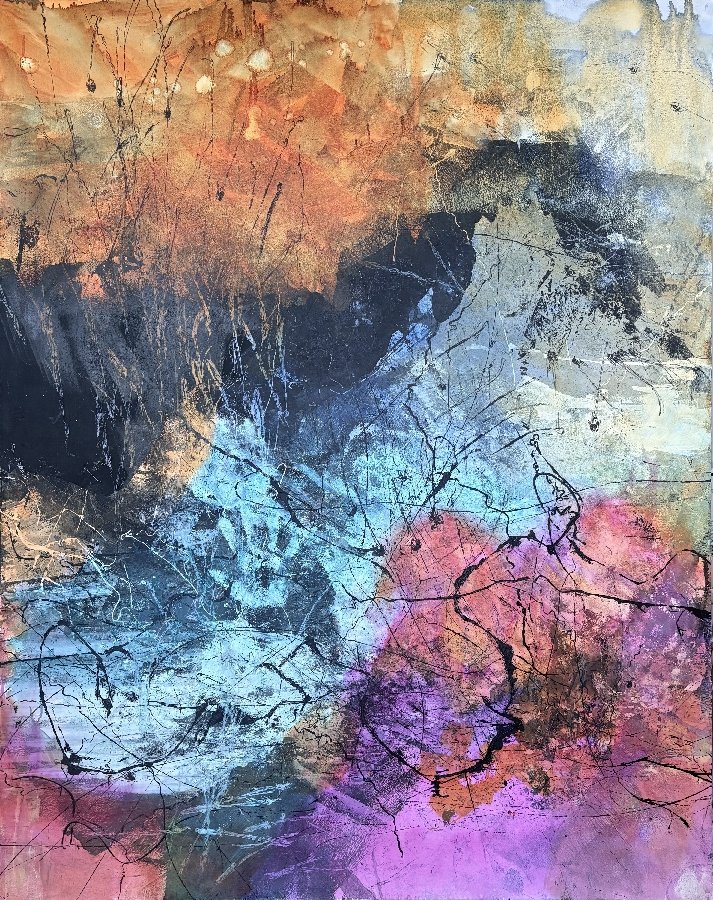
Riverbank Talks, the most recent work in the exhibition, is the most purely abstract. To make the black marks that dance across the surface of the image, she used a rope dipped in black paint and whipped it across the panel.

Reeves’s journey as an artist is best exemplified in Big Plans, a triptych on fabric that she completed in 2020, picturing a woman building — or perhaps inspecting — architectural plans. The ground of the painting is a blue so deep that it feels as if you could sink into it. It’s dirtied with splotches of black ink, like spills on an architect’s floor. The dynamism inherent in Reeves’s work is fully charged here: in her agile movement between abstraction and figuration, painting and drawing, and in the image of the woman, caught up in the process of becoming.
Larger Than Life
The event: An exhibition of work by Jackie Reeves
The time: Through July 19; opening reception: Friday, May 22, 6 p.m.
The place: Provincetown Art Association and Museum, 460 Commercial St.
The cost: $15 general admission
[ad_2]
Source link