[ad_1]
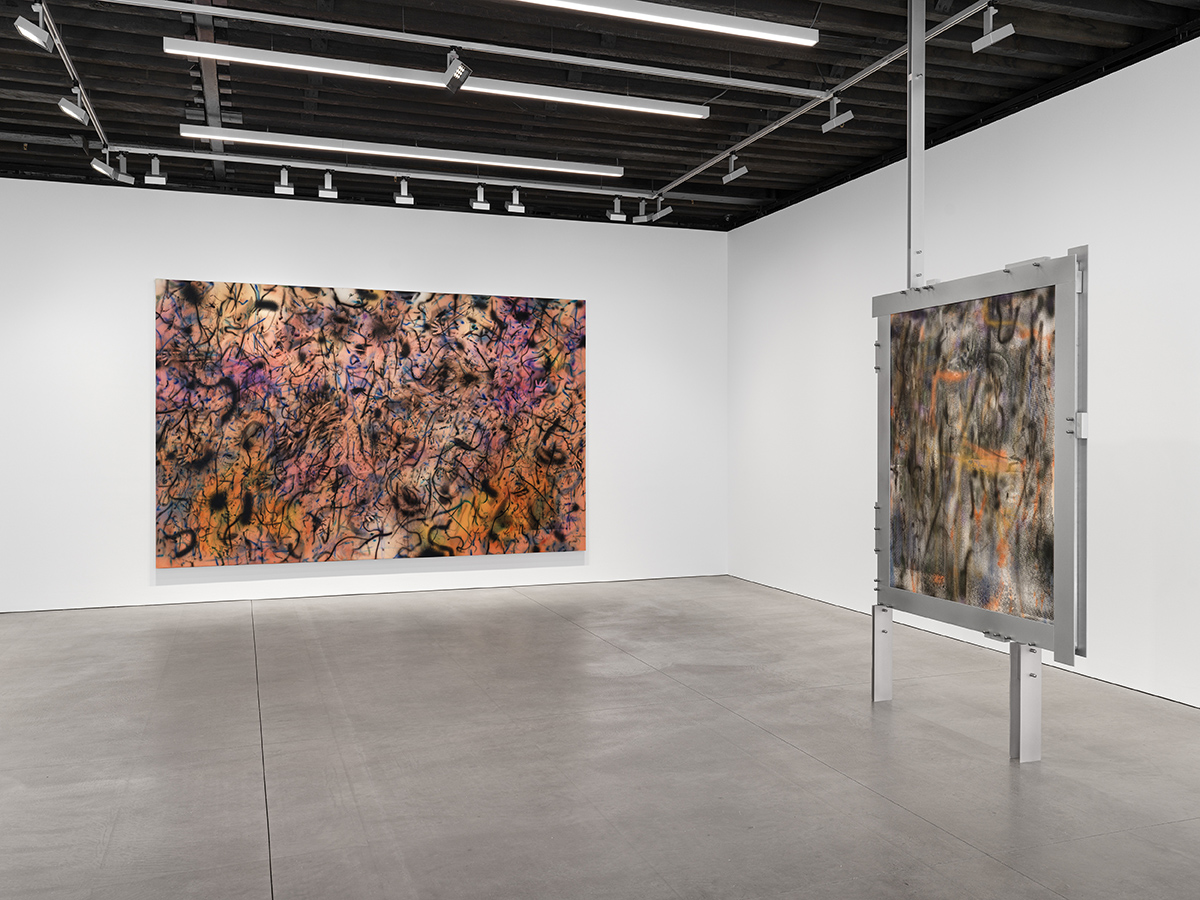 Exhibition view, Julie Mehretu, Our Days, like a Shadow (a non-abiding hauntology), Marian Goodman Gallery, New York, 2026 Courtesy of the artist and Marian Goodman Gallery Photo credit: Alex Yudzon
By Margherita Artoni May 21st, 2026
With Our Days, Like a Shadow (a non-abiding hauntology), presented at Marian Goodman Gallery (April 14 – June 6, 2026), Julie Mehretu pushes painting beyond the status of image. What remains is not representation, but environment: a field where perception is continuously reorganized under conditions of density, dispersion, and historical and visual overload.
The exhibition arrives after the retrospective moment. That temporal fact matters. Once a practice has been fully absorbed by institutions, painting no longer needs to declare itself. It circulates instead in a different regime—post-visibility, or what might be called a post-retrospective condition. Meaning is no longer produced through distance and overview, but through immersion without exit.
Across the works, composition stops behaving like structure. Gesture, transparency, and fragmentation do not organize the image; they tend to destabilize it. The viewer is no longer outside the work, but often caught within its shifting perceptual field.
Abstraction persists, but not as reduction. It accumulates. Cartographic traces, architectural debris, linear accelerations—none resolve into orientation. The surface behaves less like a plane than like a field of delayed recognition, where reading is constantly deferred by visual excess. Foster’s logic of the archive is relevant here only insofar as it describes accumulation without synthesis: images that refuse to settle into meaning.
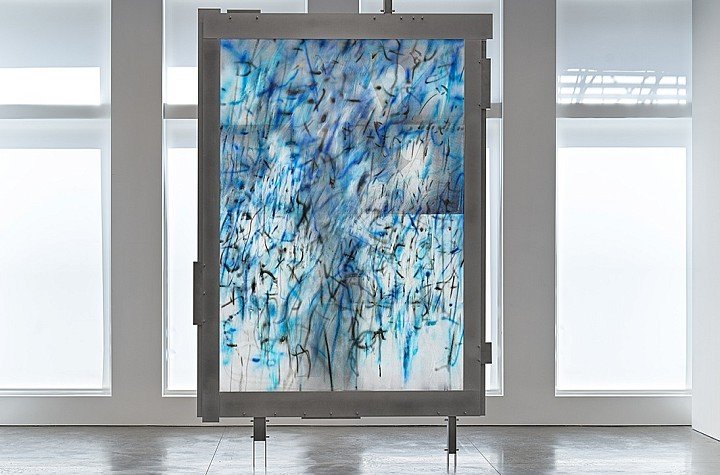
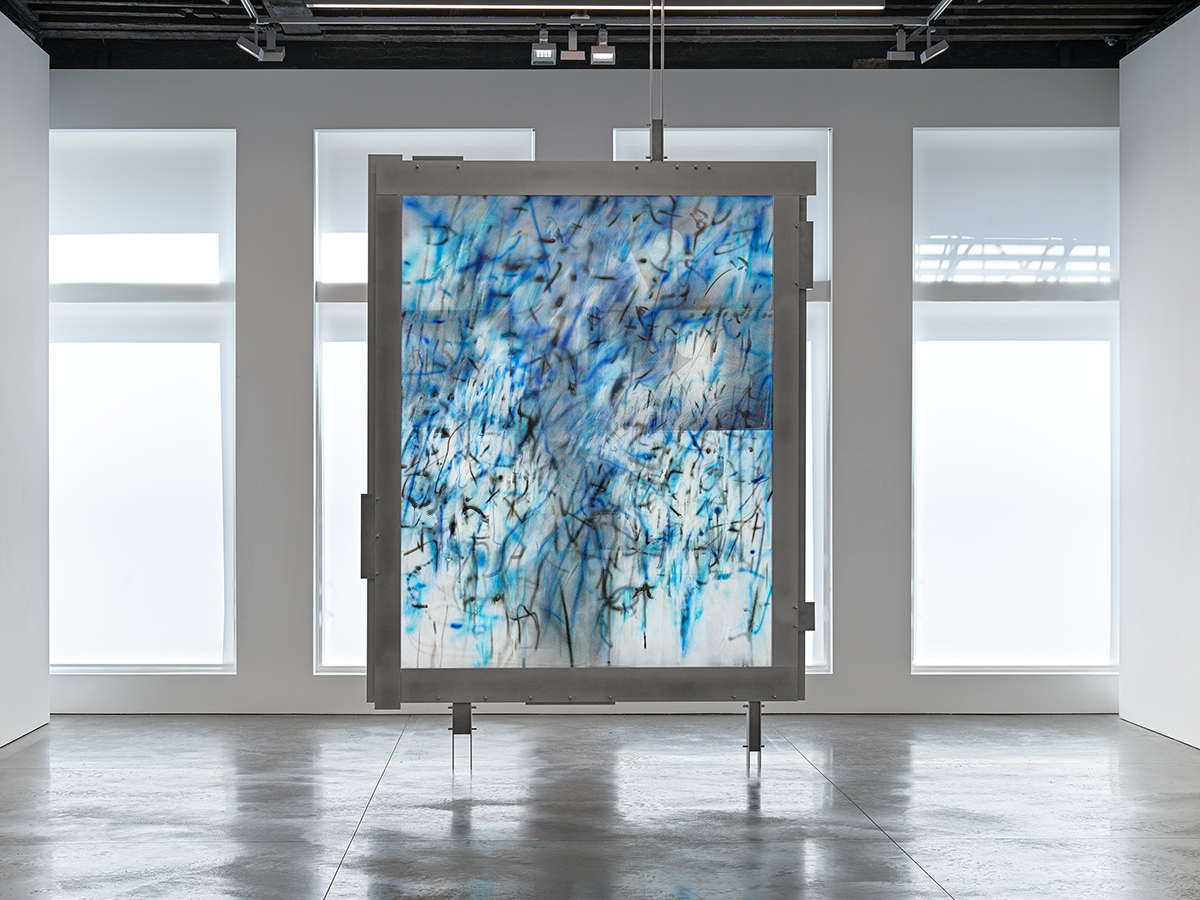 Julie Mehretu / Nairy Baghramian TRANSpaintings (the substanceless blue pour of tor and distances) / Upright Brackets, 2025-2026 Ink and acrylic on monofilament polyester mesh in an aluminum sculpture Painting: 120 x 96 in. (304.8 x 243.8 cm) Sculpture: dimensions variable Courtesy of the artists and Marian Goodman Gallery Photo credit: Alex Yudzon
At the same time, painting no longer holds its medium boundary. What Krauss once called the post-medium condition has in many ways mutated here into spatial expansion. Painting becomes infrastructural without becoming literal architecture. It behaves like space thinking itself.
This is clearest in Our Waste Places (2024–2026), a large-scale body of work in which Mehretu extends her practice of layered abstraction into a more explicitly sedimented field of visual debris. The works are built through successive strata of gestural marks, architectural diagramming, and digitally sourced fragments that behave like residual “after-images” of contemporary conflict and urban transformation. Rather than resolving into a single pictorial logic, the paintings operate as unstable accumulations: surfaces where erasure and inscription coexist. Dense black passages and translucent overlays produce a sense of shifting ground, where spatial orientation is constantly undone. The viewer encounters not a composition but a continuously reorganized field of perceptual pressure, in which image fragments appear, dissolve, and re-emerge without stabilizing into representation.
What matters is not what is depicted, but how attention is forced to behave. Perception oscillates between focus and dispersal without ever stabilizing. Sze’s logic of accumulation is present as a distant reference, but Mehretu pushes it into a more compressed and less navigable field. Even Richter’s blur feels too optical here—this is not doubt, but saturation.
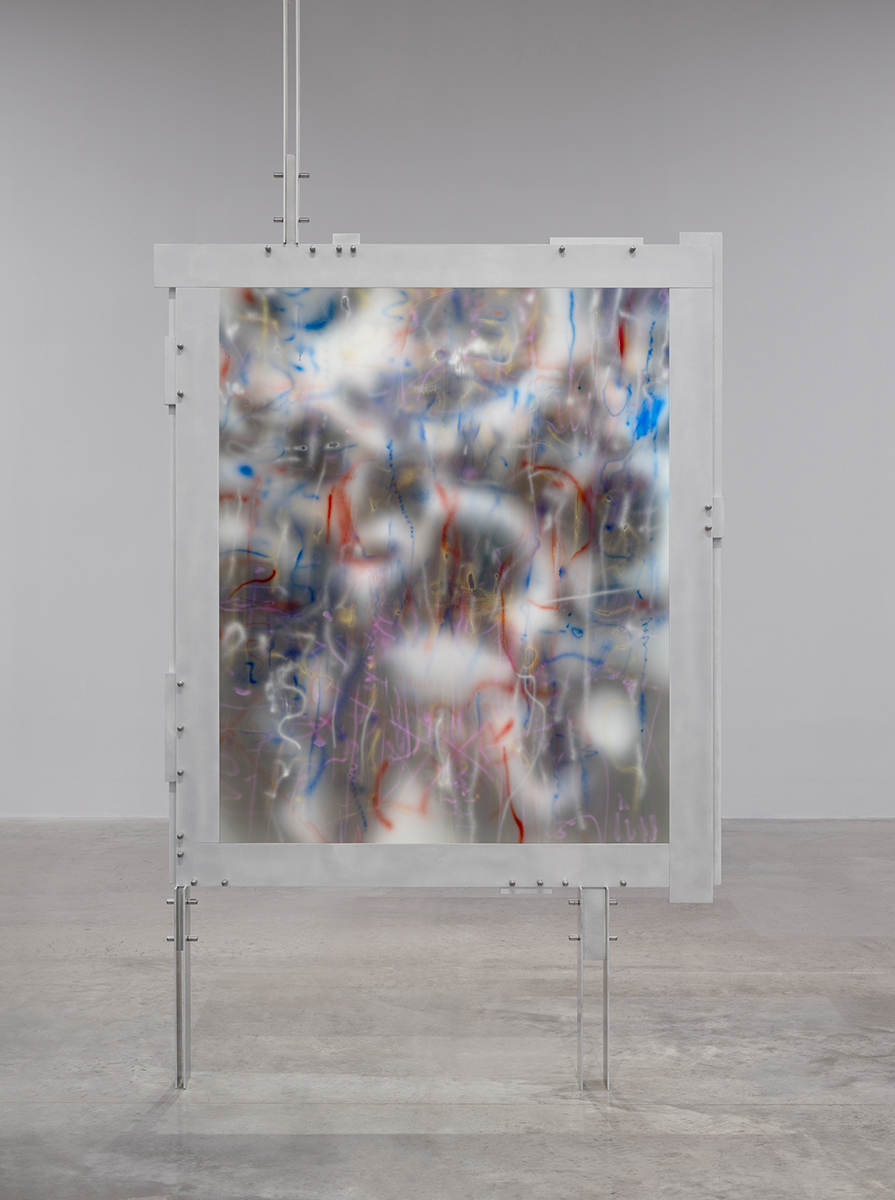 Julie Mehretu / Nairy Baghramian TRANSpaintings (ecto) / Upright Brackets, 2024 Ink and acrylic on monofilament polyester mesh in an aluminum sculpture Painting: 72 x 60 in. (182.9 x 152.4 cm) Sculpture: dimensions variable Courtesy of the artists and Marian Goodman Gallery Photo credit: Tom Powel Imaging
The phrase a non-abiding hauntology does not point to memory or loss. It describes a present that cannot hold itself still. Nothing returns because nothing leaves. What persists are residues that never fully detach from perception in the first place.
Inside Totality (2025–26) intensifies this condition. Black is not used as depth or symbol but as an active surface of absorption and partial return. Forms appear only long enough to register, then dissolve back into opacity. What surfaces—fragments, diagrams, partial figures—never stabilize into image. They behave like interrupted signals rather than pictorial elements.
In TRANSpaintings (the substanceless blue pour of tor and distances) / Upright Brackets, 2025–2026, developed with Nairy Baghramian, painting leaves the wall entirely. Suspended mesh, ink, acrylic, and sculptural framing produce a condition in which viewing is no longer frontal. Movement changes what exists. Shadow becomes structural. The work is not seen; it is entered.
Across the exhibition, abstraction is inseparable from contemporary visual systems defined by overload and simultaneity. But Mehretu does not represent these conditions—she constructs them. The result is not an image of circulation, but circulation as image.
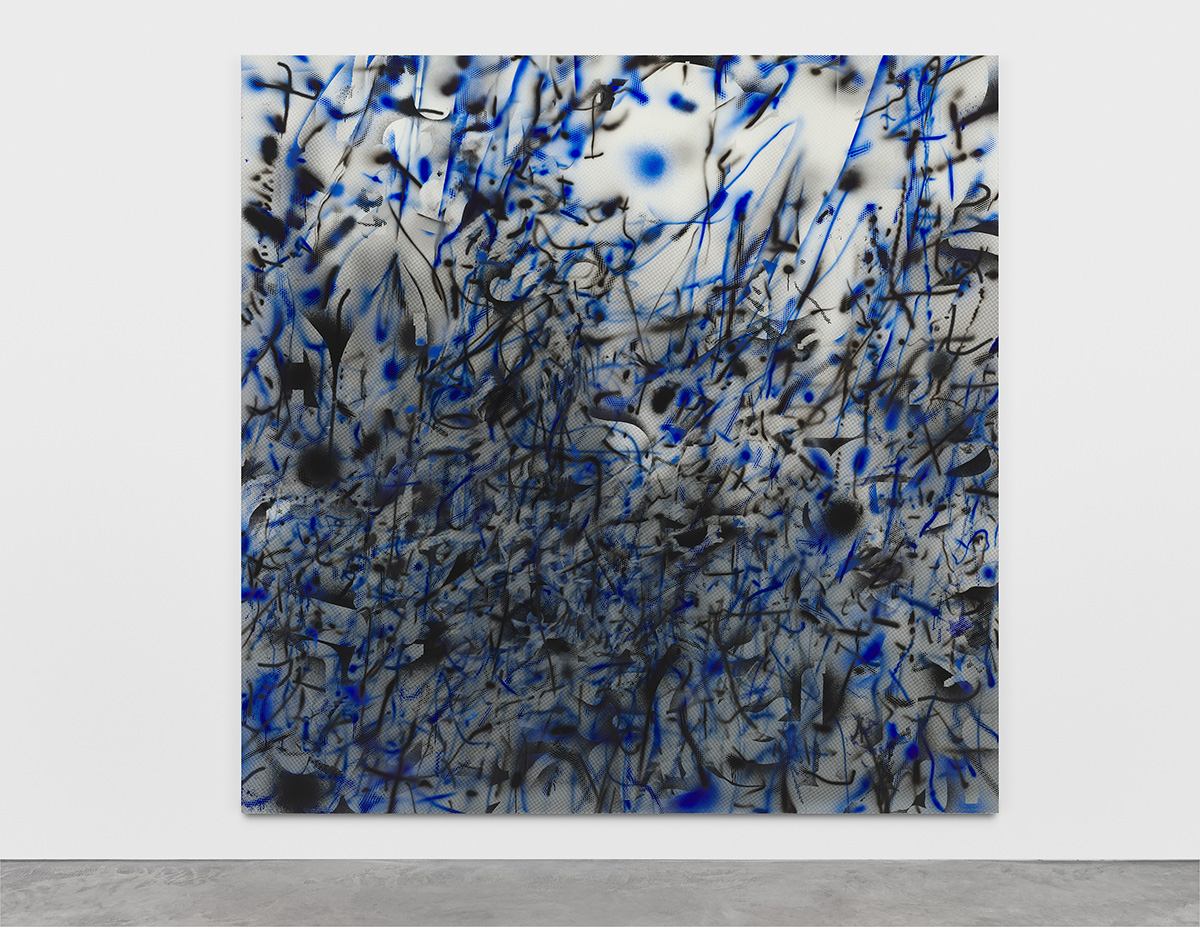 Julie Mehretu The Wine-Dark-Sea, 2023-2026 Ink and acrylic on canvas 120 x 120 in. (304.8 x 304.8 cm) Courtesy of the artist and Marian Goodman Gallery Photo credit: Tom Powel Imaging
After canonization, painting no longer performs legitimacy. It operates in a regime where visibility is already given, already exhausted. What remains is not affirmation but instability: a constant negotiation between emergence and disappearance.
Mehretu ultimately reframes painting as a perceptual system without stable ground. Image, space, and attention collapse into one another. Nothing resolves because nothing is meant to. What is left is a field that continues to organize seeing even as it refuses to become readable.
[ad_2]
Source link