[ad_1]
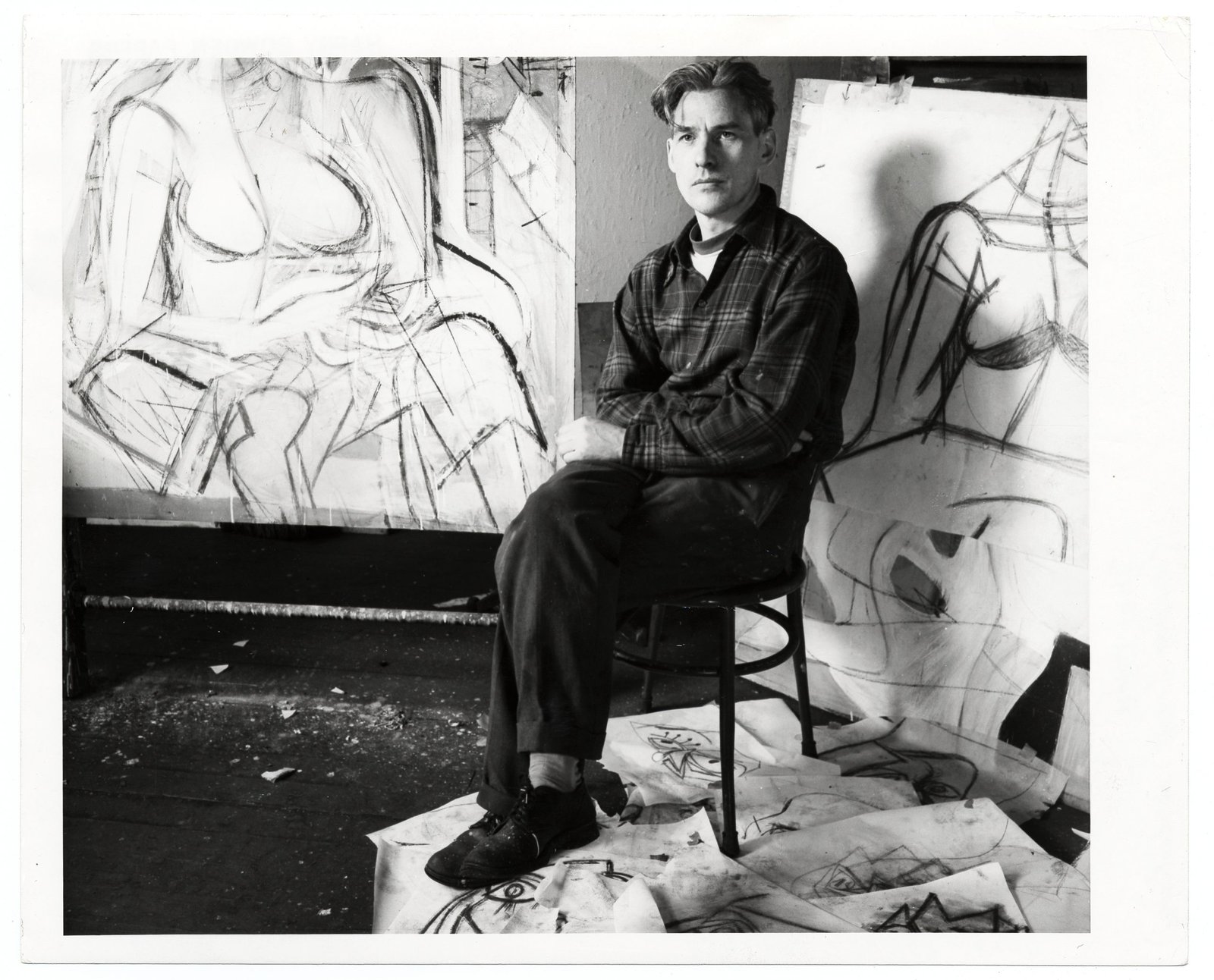
Willem de Kooning is best known for his frenetic, abstract canvases, but another aspect of his practice has long escaped attention: his drawings. A forthcoming exhibition at the Art Institute of Chicago (AIC) is set to correct that oversight.
Although the Dutchman would come to upend the traditions of painting, de Kooning was, in many ways, an artist with one foot in the old world. He admired the likes of Ingres and Rubens and had been schooled at the Rotterdam Academy in the early years of the 20th century. There, he’d been drilled in draftsmanship and had spent years copying from casts and antiquities just like the Old Masters before him.
By the time he arrived in America in 1926 (as a stowaway aboard a British freighter), de Kooning was, in short, an exceptional draftsman. An early charcoal, Dish with Jugs (1919 to 1921), for example, renders the light and grooves of its subjects so faithfully it appears like a sepia photograph. The Dutchman didn’t differentiate between drawing and painting: at times, drawings fed into paintings; at others, charcoal and graphite joined paint as marks upon the canvas.
The AIC show, “Willem de Kooning Drawing,” opens in June with more than 200 works to reveal how drawing was central to de Kooning’s creative process. Here, his drawings will be gathered alongside a handful of paintings, sculptures, and prints—many of these pieces never having been exhibited together before.

Willem de Kooning, Dish with Jugs (1919 to 1921). Photo: courtesy The Metropolitan Museum of Art, New York.
“Drawing was arguably his greatest gift,” the show’s curator Kevin Salatino said over email. “When he made the decision to become an artist, he quickly realized that to make his mark he needed to free himself of what he had learned at the Academy.”
Just how much did de Kooning draw? More than 2,000 of his drawings survive — the number of lost drawings, Salatino says, is “remarkable.” In a typical retrospective, drawings serve to explain or contextualize major paintings. At AIC, they’re the main course, confounding boundaries de Kooning himself didn’t observe.

Willem de Kooning, Two Women’s Torsos (1952). Photo: The Art Institute of Chicago.
Take Two Women’s Torsos (1952), a dense tangle of pastel, charcoal, and graphite that the museum bought in 1955. It was created at the height of Abstract Expressionism and sees the artist riffing off his series of Woman paintings and developing the theme further (he would drew the subject nearly 100 times). In a bold gestural hand, pastel and charcoal work in tandem, pushing back against traditional modes of composition.
Over time, he began to challenge himself, creating obstacles to his long-honed skill. He’d draw with his left hand or both hands at once and observe the results. “Willem de Kooning Drawing” follows these experiments of the 1960s including his stint drawing with his eyes closed. The device had been pioneered by the Surrealists in their pursuit of the subconscious, but for de Kooning the focus was more about freeing the hand from the eye and undoing his training. “I have an image in mind,” he once said of the practice, “but the results always surprise me.”
One surprise for Salatino was the realization that the artist’s paintings were not the spontaneous creations of a brilliant eye and hand. As the drawings show, oftentimes they were carefully planned. Drawing was so fundamental to the way de Kooning thought as an artist,” Salatino said. “Without the drawings, one cannot fully understand him or his art.”
The exhibition, marking the first de Kooning solo presentation at the AIC since 1969, was organized in partnership with the Rijksmuseum and will travel to the Amsterdam institution in October.
“Willem de Kooning Drawing” is on view at the Art Institute of Chicago, 111 S Michigan Ave, Chicago, Illinois, June 14–September 20.
[ad_2]
Source link