[ad_1]
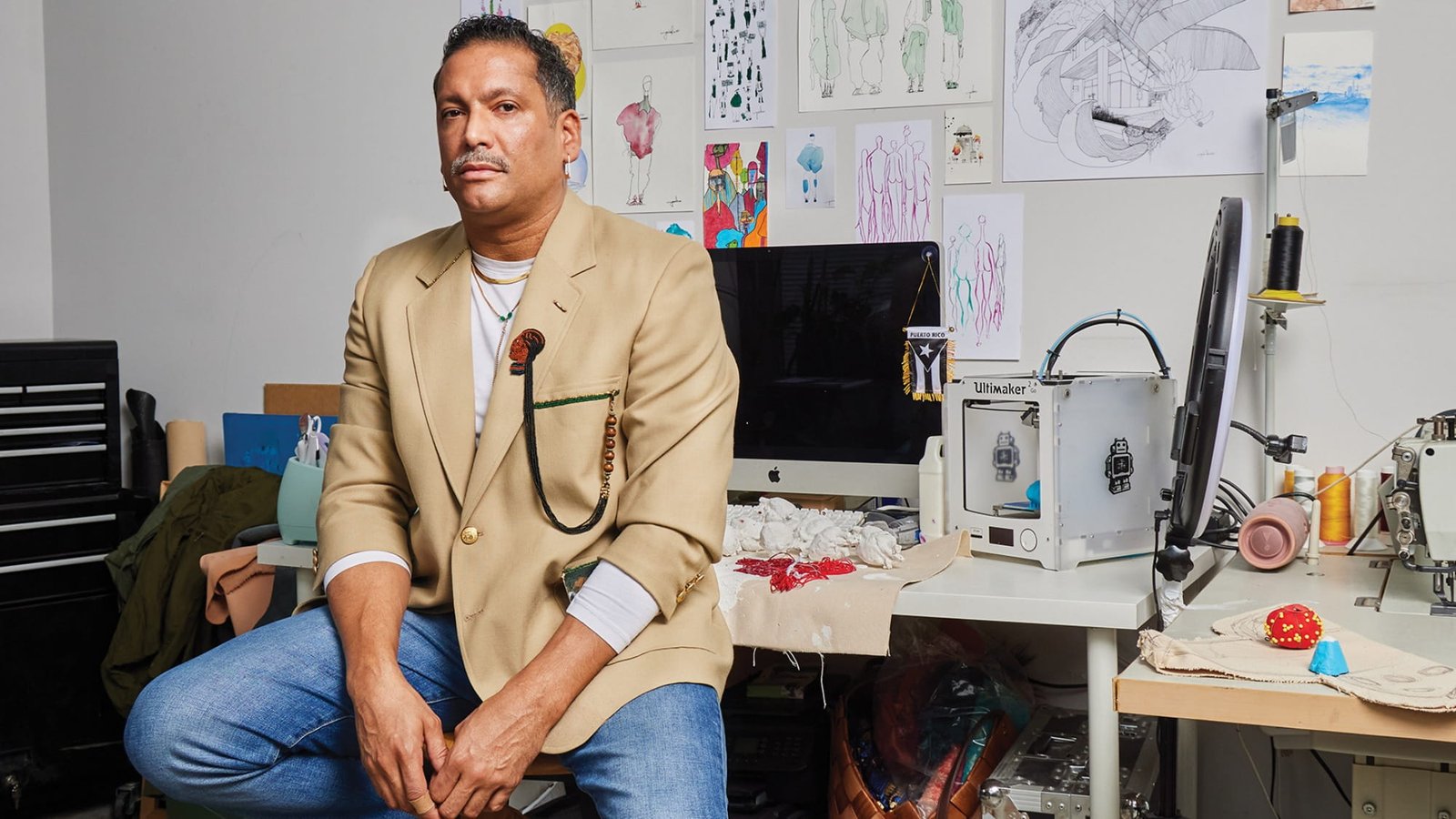
Walking into the studio of Gabriel-Bello Díaz feels like entering a laboratory where the future and past converge. A 3D printer whirrs as it lays down filament on one worktable; across the room, a vintage industrial Singer sewing machine is piled with canvas and rolls of red, brown, and ochre leather. Díaz—aka GABO—has a few high-tech tools up his sleeve. And a few degrees. He holds a Bachelor of Architectural Engineering, a Master of Science in Civil Engineering with Sustainability, and a Master in Advanced Architecture. Still, the inspiration that fuels his practice is wide-ranging: Surrealist free-association, Taino mythologies, and Yves Saint Laurent fashion drawings from the 1970s.
A garment rack against one wall holds upcycled vintage coats. One floor-length coral-colored trench drips black fringe down its back, from collar to hem. Another coat, in aubergine wool, has been cropped and embellished with intricate hand-beaded appliqué in the shape of a face across the chest, with strands of violet beaded hair sweeping over the shoulder in a cascade. Beyond the rack, the wall is filled with paintings of small fi gures dressed in splashes of color.
“It’s always about old material and new tools,” Díaz says about his work. “Finding ways to mix those two things—and letting the story emerge out of that.”
Born in london to puerto rican parents and raised in New Jersey, Díaz was one of those kids who loved to draw and dreamed of making big things. By the time he graduated from Wentworth Institute of Technology at 20, he’d already established an eponymous architectural design fi rm with more than 70 clients. The only problem: Drawing plans for bathrooms and parking garages didn’t fully scratch his creative itch.
“It’s always about old material and new tools. Finding ways to mix those two things—and letting the story emerge out of that.” —Gabriel-Bello Díaz
Díaz enjoyed using the tools, processes, and software involved in the design field, so he chased architecture around the world. After a stint in Germany, he went to the University of East London for a master’s degree, and eventually to the Institute for Advanced Architecture of Catalonia in Barcelona.
“The program there was about future materiality and processes, robotics, and coding,” Díaz says. “I was thinking, if this doesn’t reinvigorate my interest in architecture, I’m gonna be a chef and open a bodega somewhere back in Germany.”
Díaz flourished in robotics research but still felt boxed in; academic robotics was fun, but too removed from real-world application.
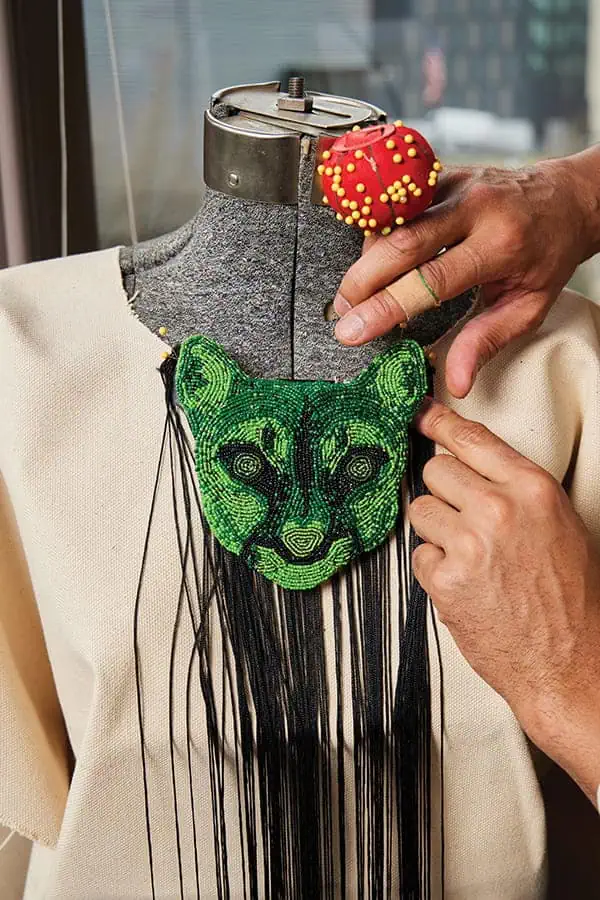
While Díaz embraces technology in his work, hand drawing and painting are still a major part of his artistic practice.
PHOTO by OLLI TUMELIUS
When Díaz moved to Seattle in 2014 to be closer to his father, he encountered limitations with the existing maker spaces. “They didn’t follow the FabLab philosophy I was used to,” he says, explaining FabLab as being “like the metric system of maker spaces.” Since he couldn’t find exactly what he was looking for, he started SoDo Makerspace.
There, he connected with the local nonprofit Technical Access Foundation and began teaching engineering and entrepreneurial skills to underserved youth in public schools. One project in the curriculum he developed for TAF Academy—teaching basic website building—accidentally gave birth to his first fashion business.
“I was like, let me actually show them what building a website looks like,” Díaz says. “I remembered I had a pile of leather samples from a couch store lying around and thought, I’ll make some cute little clutch bags.”
From that pile of scrap and a website demo, Efficio was born. The laser-cut leather accessories, stocked at Standard Goods, were so popular that Díaz couldn’t keep up with demand. Fashion followed: suspenders, harnesses, and more bags.
“I realized what I was getting into was customization through sustainable practice,” he says. “Finding materials, repurposing them, and using machines to create newness. It birthed a genre I’ve found myself in: mixing fine arts with digital fabrication.”
From traditional hand-beading to robotics-assisted printing, cutting, and design, few skills have gone unlearned by Díaz. Recently, he’s become more public with his painting—a discipline he’s practiced for years. Drawing from his surrealist toolbox, he developed a process that begins with abstract blots of color that evolve into figures and garments. The resulting series, Mi Gente, feels rigorously calligraphic and intimate, a style informed by architectural gesture drawing and fashion illustration.
“After a while, I realized the common thread running through all these things is storytelling,” he says. “That’s the most interesting part to me. Now I think in terms of using all these mediums to tell specific stories—about my health, my background as a queer man, being Puerto Rican, Taino narratives.”
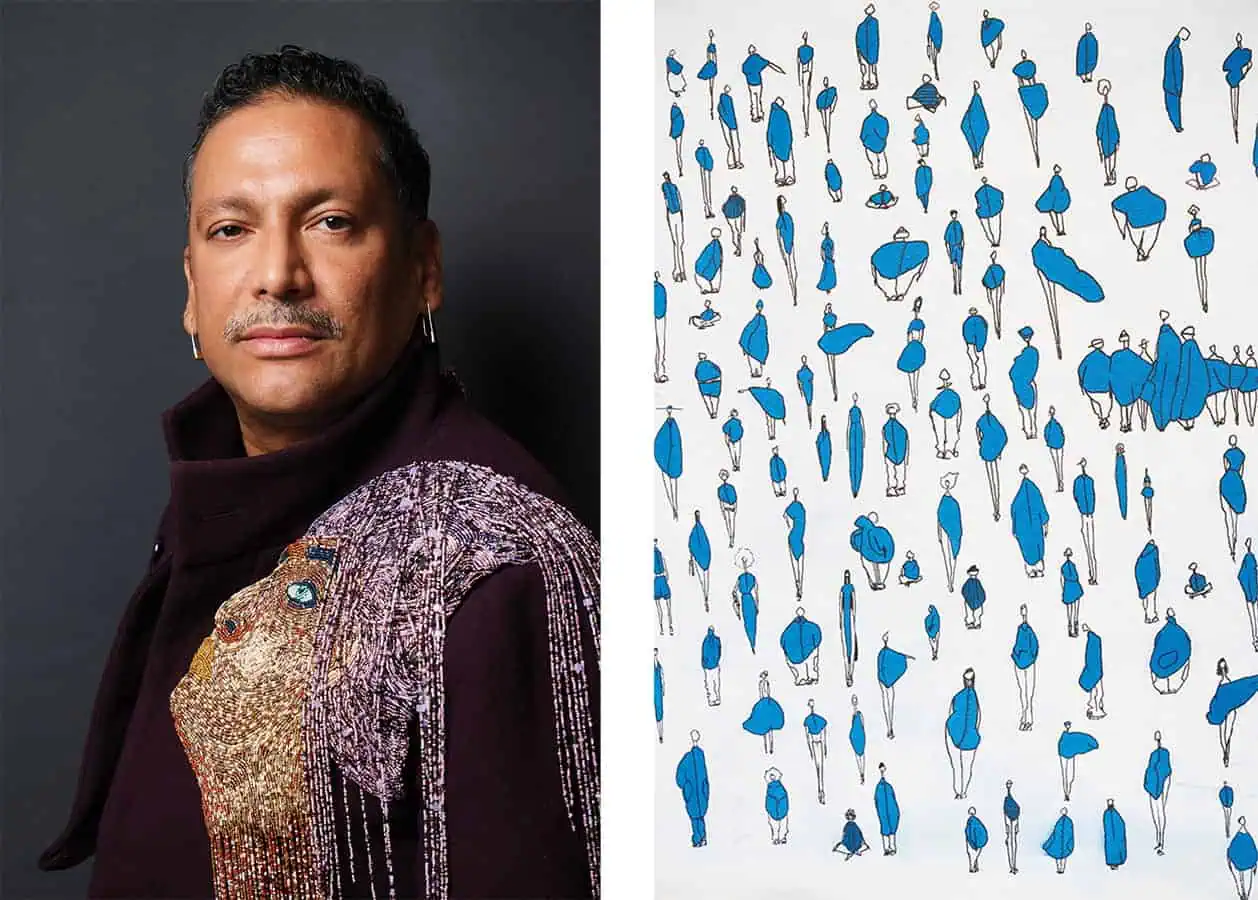
Outside the lines. Gabriel-Bello Díaz works proficiently between mediums, producing intricately beaded garments (left) and detailed drawings (right) with equal skill.
PHOTOS by OLLI TUMELIUS
His upcoming exhibition for ARTS at King Street Station (Ancestral Future: Taino Archives, June 4 – Aug. 8) brings these threads together. The show spans paintings, fashion, furniture, textiles, and sculpture to showcase the futurism of Puerto Rico / Taino storytelling through emerging technology. The blots of paint in Mi Gente inform a collection of sculptural garments with exaggerated geometries that hang, ethereal and larger-than-life, on forms suspended in the air. Closer to the ground, wearable iterations incorporate 3D printing, laser cutting, and beadwork. Augmented reality activations made in collaboration with Adrian Pacheco will transform Díaz’s 2D paintings into moving images. Other collaborations include use of biomaterial textiles by Brenda Palomino, whose fabrics are made from sea moss, coffee grounds, and banana leaves.
Each piece carries its own narrative, interweaving the histories of its materials and peoples while looking toward a design language in which reuse is not a constraint, but a playground where technology helps imagine and realize a more sustainable world. “Seattle is such a tech city, but we look at tech in a negative way,” says Díaz. “What happens when you actually support artists with it instead?”
Ancestral Future: Taino Archives runs June 4 – August 5 at ARTS at King Street Station.
[ad_2]
Source link