[ad_1]
From Santa Fe to the wider American art canon, a generation of Native American artists reclaimed Indigenous representation through colour, irony, memory and modernism.
For the better part of a century, Native Americans existed in Western art largely as subjects rendered by outsiders. They were romantic archetypes frozen in a mythologised past, stripped of individuality and agency.
Anglo-American painters depicted Indigenous life as scenery: noble warriors at sunset, stoic figures draped in buckskin, a vanishing people preserved in oil on canvas. These images were never neutral. They served a colonial narrative, positioning Native cultures as historical relics rather than living, evolving traditions.
The artists who dismantled this framework did not do so quietly. Working from the 1960s onward, principally from Santa Fe, New Mexico, they seized control of their own representation and, in doing so, altered the trajectory of American art.
The catalyst was the Institute of American Indian Arts, IAIA, founded in Santa Fe in 1962. Under the guidance of instructors such as Fritz Scholder, Luiseño, and the Chiricahua Apache sculptor Allan Houser, a generation of young Indigenous artists were exposed to Abstract Expressionism, Pop Art and global modernism alongside their own tribal artistic traditions.

Hopi with Manta
(28/200), 1976
Wood block
19.5 x 17.5 in
Framed: 29.5 x 24 in
Courtesy of Windsor Betts
The collision was electric. Scholder himself had famously vowed never to paint a Native American, yet he spent his career doing precisely that, but on terms the art world had never encountered. His Indian Series, launched in the late 1960s, presented Native figures holding ice cream cones, wrapped in American flags, rendered in the flat, saturated palette of Warhol and Lichtenstein.
The paintings were confrontational, ironic and deliberately uncomfortable. They forced viewers to reckon with the chasm between the romanticised image and the lived reality of Indigenous life in modern America.
Scholder’s student T.C. Cannon, Kiowa/Caddo, pushed further still. Cannon painted Native figures as fully contemporary people: seated beneath Van Goghs and Matisses, wearing traditional jewellery with modern clothing, existing comfortably within the global art conversation rather than outside it. His woodblock print Hopi with Manta (1976) exemplifies this synthesis: a Hopi woman depicted with the formal gravity of a Renaissance portrait, framed by geometric patterning that draws equally from Indigenous design and European printmaking traditions.
Cannon’s death in a car accident in 1978, at just thirty-one, cut short one of the most promising careers in American art. The works that survive are treasured for their rarity as much as their power.
Among the IAIA’s inaugural students were two Apsáalooke, Crow, artists whose work could hardly be more different in approach, yet whose shared commitment to cultural specificity exemplifies the movement’s range.

Crow Warrior Visions
Acrylic on Canvas
31 x 27 in
Framed: 38.75 x 34.75 in
Courtesy of Windsor Betts
Kevin Red Star, born in 1943, has devoted more than five decades to painting the ceremonies, regalia and historical figures of the Crow Nation with meticulous ethnographic precision rendered through a boldly contemporary visual language. His painting Crow Warrior Visions presents five warriors in full ceremonial dress against a luminous golden field, each figure individualised, each detail of bone hairpipe breastplate and eagle feather arrangement carrying specific cultural meaning.
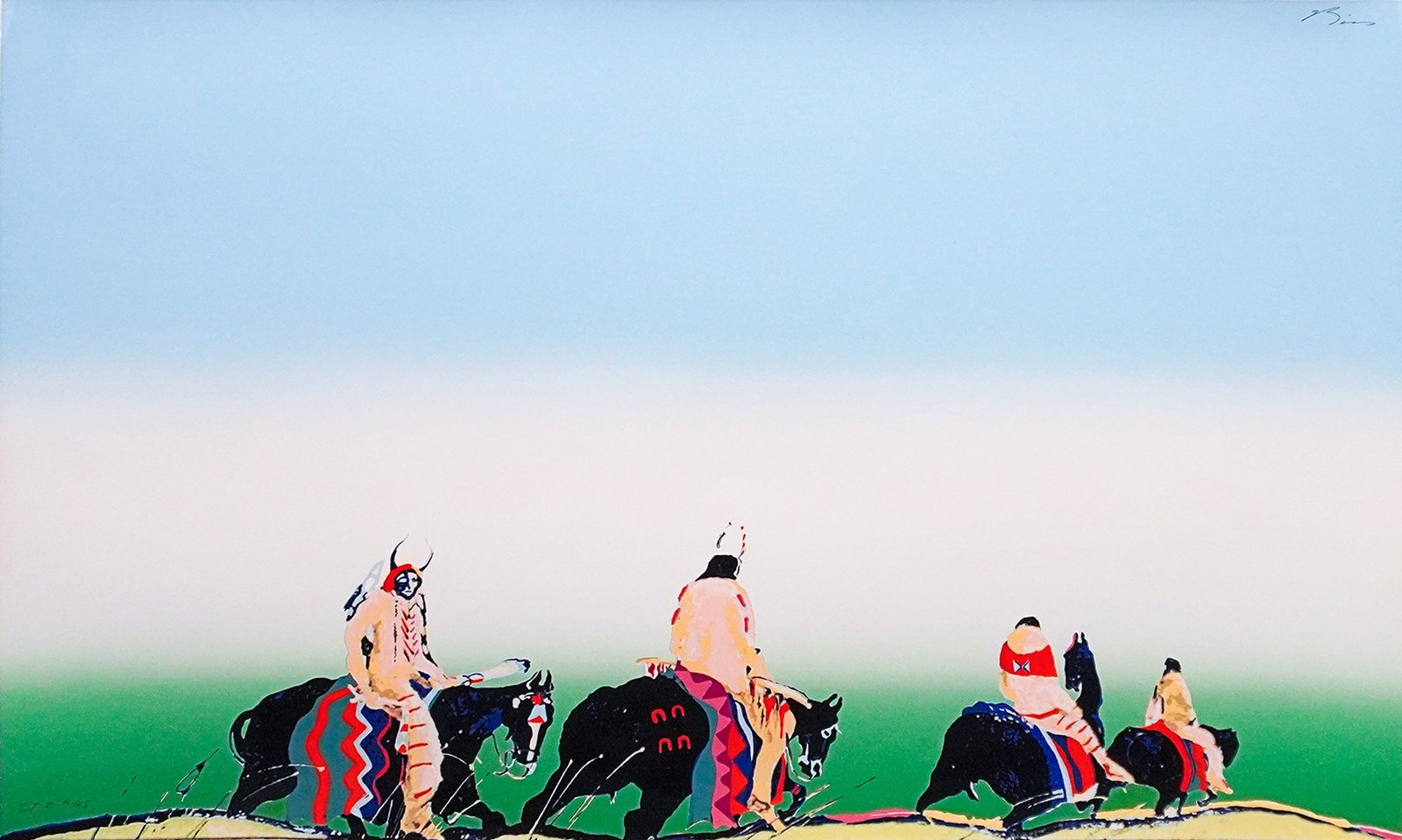
Earl Biss, 1947–1998, by contrast, channelled his Crow heritage through sweeping, expressionistic landscapes alive with light and movement. His monumental People of the Big Sky (1986) dissolves figurative form into luminous colour, evoking the vast skies and open plains of Montana through brushwork that owes as much to Turner as to any Indigenous pictorial tradition.
See also

Biss, whom Red Star called “the catalyst, like the agitator in a washing machine,” painted with an intensity that matched his outsized personality, sometimes working for forty-eight hours straight in sessions he compared to the physical sacrifice of a Sundance.
John Nieto, 1936–2018, arrived at Indigenous subject matter from yet another direction. Of Hispanic and Native American descent, Nieto brought a Fauvist sensibility to his depictions of Native life, including warriors, dancers, bead makers and ceremonial figures rendered in explosive primary colour with bold, graphic outlines.

Bead Maker
Acrylic on Canvas
60 x 48 in
Framed: 61.5 x 49.5 in
Courtesy of Windsor Betts
His Bead Maker places a single figure at the centre of a celebration of Native material culture, the composition pulsing with the electric blues, magentas and greens that became his signature. Nieto’s work bridges Indigenous and Hispanic artistic traditions, reflecting the cultural complexity of the American Southwest itself.
The significance of these artists extends well beyond the borders of the United States, yet their work remains underrepresented in international collections and discourse. The conversations taking place across the contemporary art world, from identity and post-colonial representation to cultural reclamation and the politics of who gets to depict whom, were being had by Native American artists in Santa Fe half a century ago.
For those seeking to engage with this movement, Windsor Betts Art Brokerage & Gallery in Santa Fe has spent 38 years as a specialist in Native American and Southwest art, serving as both a curated exhibition space and a brokerage facilitating the acquisition of important works by Scholder, Cannon, Red Star, Biss, Nieto and their contemporaries from private collections and estates.
In a market where culturally significant works too often pass through channels that undervalue them, Windsor Betts provides the specialist knowledge, provenance research and curatorial context that these artists’ legacies deserve.

Art Plugged is a contemporary platform inspired by a relationship with the broader arts communities. We provide our audience with curated insight into the world of art, from exhibitions to artist interviews and more.
[ad_2]
Source link