Although The Great Wave off Kanagawa is one of the most famous works of art ever made, relatively little is known about its creator, Katsushika Hokusai. David Kettle meets the team behind a new Scottish Opera production which seeks to shed some light on his remarkable life
“It’s everywhere!” laughs composer Dai Fujikura. “My wife wanted to throw away some old shoes of mine, and we realised it was on the soles of them. We went to our local Italian restaurant and the waiter was wearing an apron that had it on. There was even a guy at the gym working out next to me who had a manga version on the top he was wearing.”


You’ve probably already guessed, but Fujikura is talking about The Great Wave off Kanagawa, the iconic image of a towering column of water, stylised boats seemingly lost in the swell, and Mount Fuji sitting unobtrusively in the background. “Everyone knows the image in Japan, too,” explains director Satoshi Miyagi. “A couple of years ago, they renewed the design of the Japanese passport, and now every single page uses an image by The Great Wave’s creator, Katsushika Hokusai.”
It might be an iconic image, but how much do any of us know about the man who created it? Scottish audiences, at least, are about to find out a great deal more in a new opera, appropriately titled The Great Wave, with music by Fujikura and a libretto by Harry Ross, directed by Miyagi, which opens in Glasgow in February.
Alf-Solbakken.jpeg?crop=3:2,smart&trim=&width=640&quality=65)
And if it’s any consolation, Fujikura admits he used to know The Great Wave mainly as a smartphone emoji. It was a visit to a Hokusai exhibition at the British Museum in 2017 that first stirred his interest to find out more about the artist, whose life and career straddled the 18th and 19th centuries. “It was actually my wife who said: why don’t you write an opera about him?” It would be Fujikura’s fourth opera, and extensive research with librettist Ross turned up some scarcely believable biography. “Like, can you believe, he was struck by lightning – twice? He was still drawing at the age of 88, at a time when hardly anyone lived past 60. And he said he wanted to live to be 110. He changed his name so many times – at one point he called himself something that translates as ‘crazy old art man’. And when he was writing to a sponsor who he felt wasn’t paying him enough, he signed his name as Hekusai, which means ‘stinky fart’.”
Hokusai was clearly quite a character, and a fitting subject for opera. But let’s step back a bit. If you were thinking that Fujikura is out to showcase one of his country’s most illustrious cultural heroes – well, it’s not quite that simple. Though he was born in Japan – in Osaka, to be precise – Fujikura has lived in the UK since the age of 15, which gives him a particular perspective on Japanese culture. “When I was first starting out as a composer, I did all I could to move away from Japanese-ness – not for any nasty reasons, but because anything I did would be interpreted as being “Japanese”. For me, writing music is all about creating a utopia, the kind of world where I’d like to spend time, and where you’re very welcome too. So I don’t necessarily imagine an immigration officer being there.”

He’s written extensively for Japanese instruments – including concertos for sho, koto, shakuhachi and shamisen – but explains that he learnt about them initially from British players. The shakuhachi – a mellow bamboo flute with strong Zen associations – also features prominently in The Great Wave. “I wanted to transport the audience into the opera’s world from the very first scene,” he explains. “So we made it so that the shakuhachi is playing at Hokusai’s funeral, which opens the opera. And in the last scene, the opera moves to somewhere else entirely as the elderly Hokusai dreams, and the shakuhachi returns. It almost acts as a bridge between two worlds – maybe the living and the dead, or reality and dreams.”
Does Miyagi have anything similar planned for his staging? He’s reluctant to be drawn on specifics. “I’m thinking about it – but if I say too much, it might detract from the audience’s enjoyment.”
There’s a lot to be said, of course, for an opera that explores the biography of a little-known figure who created one of the world’s most iconic images. But, Fujikura hopes, The Great Wave will be a bit more than that. “I didn’t want to make just a documentary opera. We needed a fantasy element. After all, opera is fantasy – it’s an amazing world where we can create anything with music.” To that end, The Great Wave blends fact and fiction, biography and speculation – often unavoidably, since there are so many aspects of Hokusai’s life and career that remain a mystery. Just take the artist’s relationship with his daughter Oi, another of the opera’s central characters. She’s known to have divorced her own artist husband, possibly because he didn’t match up to her father’s genius. “Divorce was pretty much taboo in the Edo period,” explains Fujikura. “But she went back to her father, and pretty much ran his studio – she was an astute business person.”

In any case, The Great Wave promises to uncover some universal, perhaps spiritual themes beyond the artist’s biography. “Hokusai never reflected on his life or work with regret,” explains Miyagi. “He was constantly moving forward, trying new things. He seems to have died in the middle of doing work. But from my perspective, it’s almost like he had reached enlightenment in the Buddhist sense. If you look at the works he was creating towards the end of his life, it seems like he’d already arrived in Paradise.”
Fujikura concurs. “The European image of a serious artist is so often someone who’s suffering, or who’s going through pain. It’s so boring. We decided: we’re not doing that. This isn’t a person – Hokusai is a force of nature.”
Miyagi is understandably hesitant to divulge any of the specifics of his staging. “It’s best to leave that as a surprise,” he smiles. “But let’s just say that I think the stage design and direction will allow you to fully appreciate Hokusai’s greatness as a painter.”
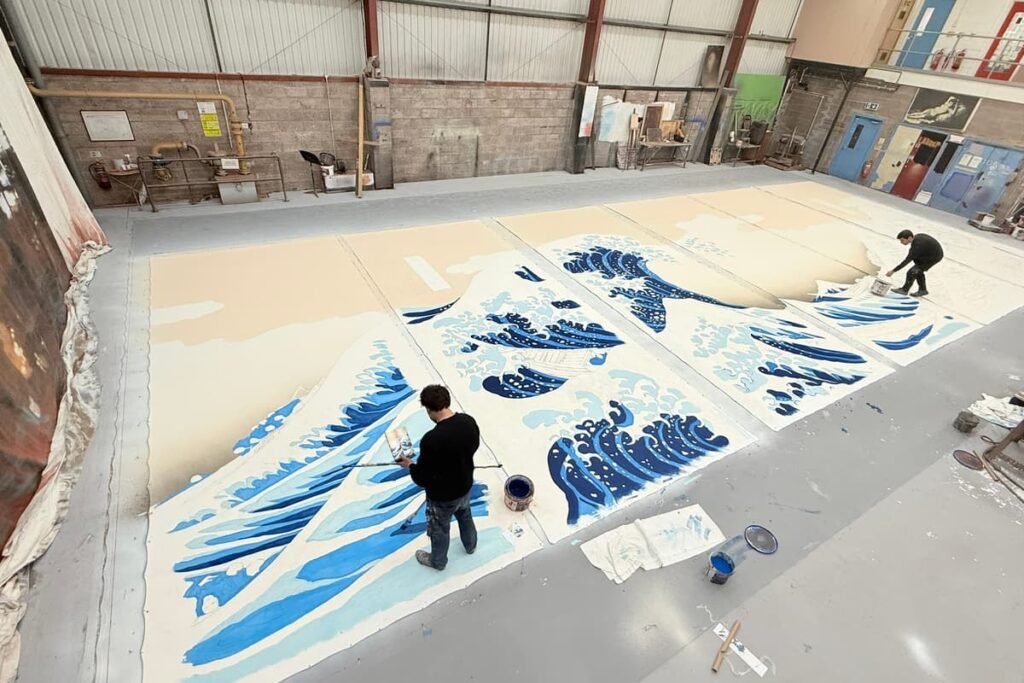
Fujikura, however, has already seen Scottish Opera’s production department working on some of the backdrops. “I visited when they were making the set: they were drawing and painting The Great Wave itself, in a version that’s about six metres high. And they were joking that that had to get it right: they can’t mess around with one of the world’s most iconic images.” Quite. And very appropriately, his new opera looks set to be a visually arresting creation that’s enlightening in many ways.
The Great Wave is at the Theatre Royal, Glasgow, on 12 & 14 February, and at the Festival Theatre, Edinburgh, on 19 & 21 February, see www.scottishopera.org.uk. This feature was produced in association with Scottish Opera
The Scotsman’s arts newsletter is now sent twice a week – subscribe today
Want the latest Scottish headlines sent directly to your phone? Sign up to our new WhatsApp channel here.