[ad_1]
The forced excitement accompanying each new iteration of the Venice Biennale, I’ve heard it said, is akin to a faked orgasm—at some point, it’s probably better to stop. Yet among this magical city’s spells, as the novelist Mary McCarthy once wrote, is “one of peculiar potency: the power to awaken the philistine dozing in the sceptic’s breast.” McCarthy had in mind “dry, prose people” who object to “feeling what they are supposed to feel, in the presence of marvels.” This, then, is the art lover’s dilemma whenever the Biennale comes around: Do you marshal skepticism or let the feelings flow?
Whatever your preference, you’ll get a lot of practice. The Biennale, which opened last week and will remain up through November, has frequently and misleadingly been called “the Olympics of the art world”—and it’s certainly a competition of sorts (primarily for attention), but no one seems to care much about who’s winning. More accurate, it’s an everywhere-all-at-once phenomenon. You try to account for it all, but it’s virtually impossible to tell a clean story about it.
This year, the buildup to the Biennale was dominated by responses to the decision by its president, Pietrangelo Buttafuoco, to allow the Russian and Israeli Pavilions to mount exhibitions. Accusations of complicity with pariah states and counteraccusations of censorship flared during the festival’s early days. In other corners, opinions ran hot about rampant nudity in the Austrian Pavilion. Yet the fervor, whether consequential or minor, in some ways has little to do with the actual physical experience of being in Venice, scouring the city for art.
There is so much of it. I saw thousands of artworks in dozens of locations for five straight days and still missed a good deal of what was on offer. The whole thing is frankly preposterous. But what reliably happens at the Biennale is that you, at some point, see something unexpected that slows you down—that makes you conscious of tiny changes in your breathing, maybe even draws a tear. It might happen in a church: in the Frari, for instance, home to Titian’s Pesaro Madonna altarpiece, the first painting I seek out every time I visit Venice. Or in a darkened room along the Grand Canal, while watching Arthur Jafa’s devastating collage of mostly found footage, Love Is the Message, the Message Is Death. You don’t, in other words, know when it might happen. But if you want it to happen, you have to remain susceptible.
On the morning of the opening day, I set off early so I could duck into the Scuola Dalmata, a small 15th-century building only minutes from the Biennale’s main entrance, to see a cycle of paintings by the great Venetian Renaissance painter Vittore Carpaccio. The most famous of these shows Saint George slaying a dragon whose human victims—reduced to skulls, amputated limbs, and severed heads—litter the ground beneath them. The dragon’s jewellike, fanned-out wing, the colonnade of receding palm trees, and the architectural backdrop are all sublime. But when you get up close, the painting is shockingly macabre.

Another painting in the cycle had been replaced by a yellowing photographic reproduction. The original was only yards away in a small room, illuminated by studio lights. Standing in attendance, like doctors in a teaching hospital, was a team of conservators funded by Save Venice, an American organization that works with local experts and authorities to preserve Venice’s artistic heritage. They welcomed me in, suggesting only that I mind my umbrella. Scuffed and pockmarked, the painting looked stoic but stripped of dignity, like an old aristocrat in a hospital gown.
A short walk away in the Giardini are the pavilions of the Biennale. As I was inspecting Carpaccios, diplomats, collectors, and press were mentally preparing for an art-viewing marathon punctuated by endless dreary speeches about the importance of art in a turbulent world. When I arrived at the Russian Pavilion, Aleksei Paramonov, the Russian ambassador to Italy, was being led through the building by the exhibit’s commissioner, Anastasia Karneeva. (Karneeva, I learned later, is the daughter of Nikolay Volobuyev, the deputy chief executive of Rostec, the state-owned Russian defense corporation.) Suddenly, all hell broke loose.
Dozens of women dressed in black clothes and pink balaclavas had gathered outside the pavilion. It was raining. They began setting off smoke flares—pink, blue, yellow. They chanted slogans (“Blood is Russia’s art!”; “Disobey! Disobey! Disobey!”), danced to loud music, climbed the pavilion’s external structures, and bared their chests to reveal more slogans. This, of course, was Pussy Riot, the performance artists and anti–Vladimir Putin activists who, since 2012, have disrupted a World Cup final, a Winter Olympics, and—most famous and at great cost—a Russian Orthodox cathedral in Moscow. For 20 minutes, they basically tore the place up. The Russian ambassador cowered inside the pavilion. A helicopter hovered overhead.
Important people speaking at exhibition openings will tell you that art is about communication. They’re not wrong. But because some crucial part of artistic expression is always slipping toward the incommunicable, the most powerful art is sometimes less a dialogue than a soliloquy. Pussy Riot’s performance felt this way: They crave justice, they’re willing to risk blacklists and prison, and they’re creative. They know how to communicate. But look past those pink balaclavas and into their eyes, and it’s clear that their hearts are broken in ways that they’ll never truly communicate to us in the crowd, clutching our cellphones.
The performance represented a rare vital moment at the center of the otherwise-lackluster exhibitions in the Giardini and the adjacent Arsenale. But the satellite exhibits spread across the city have, in recent years, become the best reason to visit the Biennale. These are high-quality, reputation-making shows, and they’re installed in some of the city’s most beautiful churches, palazzi, and museums.
Many of this year’s exhibits address war and suffering. Michael Armitage, a British painter born in Kenya, updates old-style history painting with fresher, journalistic impulses to produce compositions—of chicken thieves, migrants crammed on rafts, crowds facing COVID-era curfews—that feel strangely dreamlike. All reveal his extraordinary flair for color: lilac and dull greens undergirding local outbreaks of yellow, turquoise, and red.
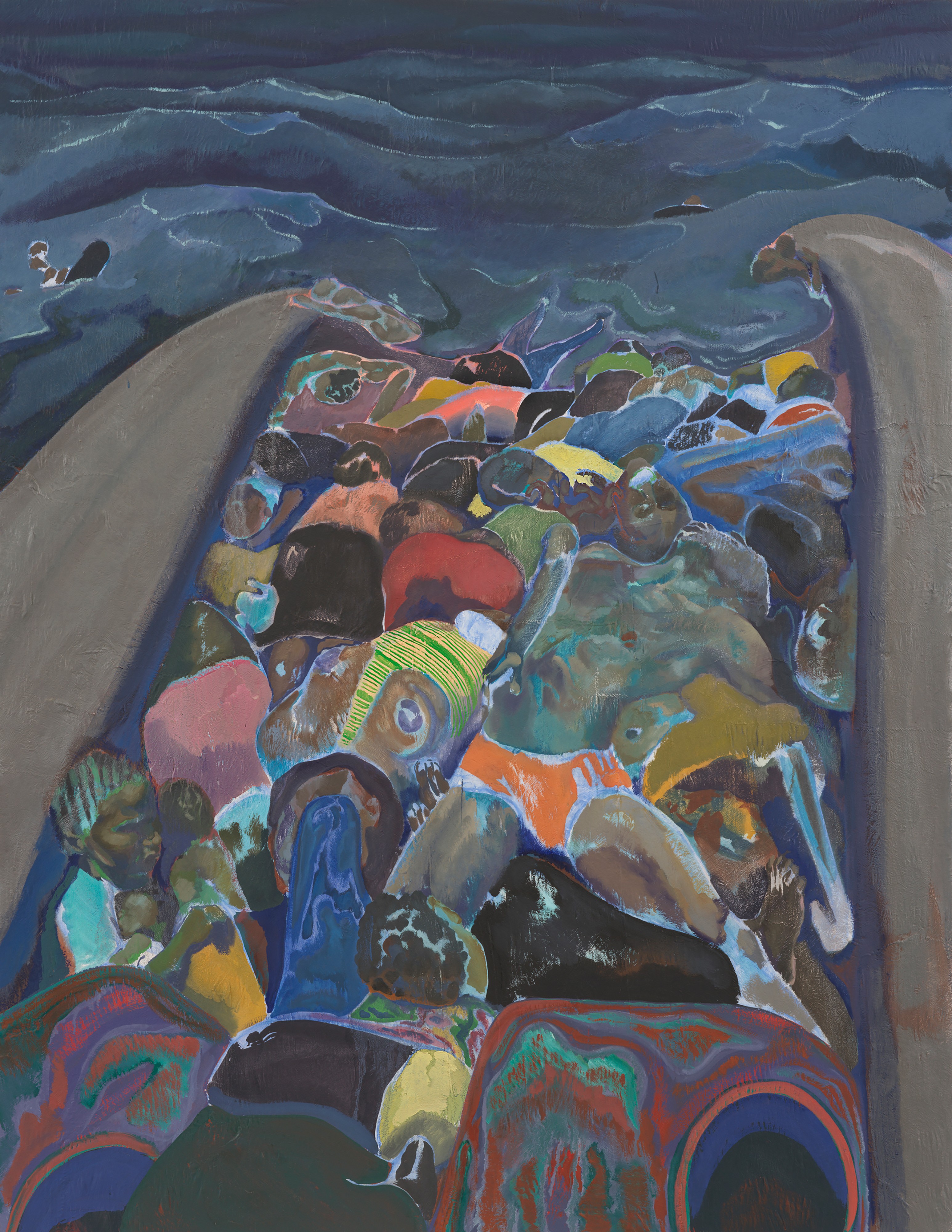
Armitage’s show, at the Palazzo Grassi, contains allusions to the etchings of Francisco Goya, so it complements Nalini Malani’s dazzling, large-scale animations projected in darkness at the Magazzini del Sale. Malani, an Indian artist in her 80s, uses a fast-paced collage aesthetic, layering her own imagery over appropriated artworks, including Goya’s Disasters of War etchings, all accompanied by her own anti-war voice-over. Her sequence of animations forms a colonnade of colored light in this narrow, high-ceilinged former salt warehouse. Both the Malani and Armitage shows left Jenny Saville, the British painter of magnified bodies and faces, with a solo show at the prestigious Ca’ Pesaro, looking mannered and lost. (If competition is not the point in Venice, comparisons are nevertheless inevitable.)
Another superb show featured Matthew Wong, a painter of intimate, hauntingly lovely figurative works inspired by van Gogh and Matisse. Wong died suicide at the age of 35, in 2019. Seeing his smaller, brightly colored, sometimes heavily patterned works in the rooms of the Palazzo Tiepolo Passi, their walls painted tomato red or pale green, with shafts of light coming through the pale-curtained windows, was my favorite experience of the Biennale. While I was there, everything seemed to rhyme, both within and beyond the paintings: the patterns, the colored light, the interiority, the intimacy.

The Biennale is best understood as a massive, citywide festival of art in three parts: the national pavilions, in which countries choose their own artists to show; the main exhibition (a curator, with a vague theme in mind, selects work by international artists—110 of them this year); and, finally, those satellite exhibitions staged all across Venice.
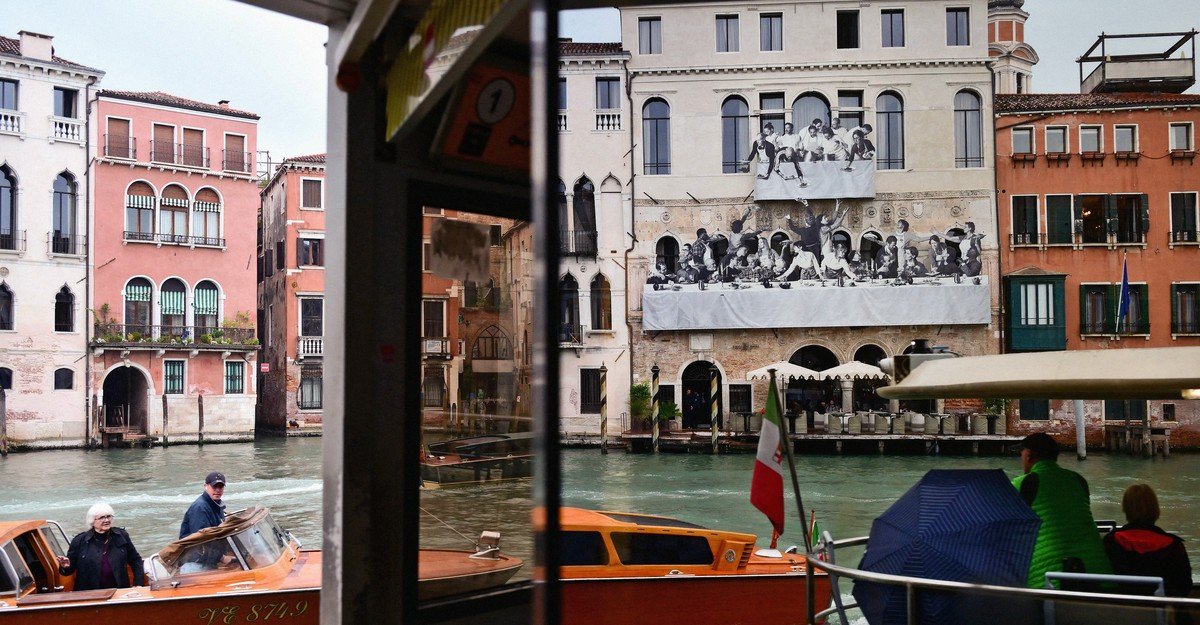
The national pavilions and main curated exhibition have been steadily getting worse over the more than two decades I’ve been attending. “In Minor Keys,” the main exhibition this year, was to have been organized by Koyo Kouoh, an admired and beloved curator who was born in Cameroon and educated in Switzerland. Kouoh died a year ago, days after being diagnosed with liver cancer. Several tributes to her are visible in Venice—most notably a giant mural by the American artist Derrick Adams on the facade of a palazzo near the Arsenale.
Kouoh was only months into the job, but she had come up with an outline, and after a meeting in Dakar, Senegal, shortly before she died, a five-person committee was charged with carrying out her vision. Sad to say, but perhaps unsurprising under the circumstances, it’s a flop—an avalanche of slapdash assemblages, clumsy painting, human figures morphing “surreally” into bouquets of found objects, and random-looking installations. Elaborate wall labels drum relentlessly on themes of identity politics, the ecological crisis, colonialism, and wellness. No artist, it seems, can stick to a single medium. One, we are told, “has developed an interdisciplinary practice that spans painting, drawing, sculpture, tattoo, poetry and sound.” Throughout the show, wall labels repeatedly refer to each artist’s “practice,” cant designed seemingly to encourage an endless unspooling of arbitrary-looking art “product” and to repress a basic reality of art making—the struggle to create objects with their own unique resonance and autonomy.
A few works did stand out. I loved a giant embroidery by Thania Petersen, a South African of Afro Asian Creole descent. A fantastical map tracing the migration of Sufi music in Africa, it superimposes Sufi iconography over a 17th-century South African coastal landscape, features a rich array of plant life, and is populated by whirling dervishes riding on flying fish. I was seduced, too, by a four-channel video installation by Cauleen Smith, a Los Angeles–based artist. Her work is a very private-feeling meditation on what it’s like to live in that city. It includes footage of softly lapping ocean waves, wheeling birds, the Watts Towers, freeways, protests, and the city center at night. It’s all set to gorgeous music that Smith commissioned, and keyed to the writing of the great L.A. poet Wanda Coleman.

Meanwhile, the national pavilions this year tended toward the embarrassing, the way that only committee-driven, compromise-riddled projects can be. One exception (it’s embarrassing precisely because the artist didn’t compromise) was the aforementioned Austrian Pavilion, converted into what the artist, Florentina Holzinger, calls “Seaworld Venice.”
Holzinger is a performance artist working in the taboo-breaking tradition of the Vienna Actionists, who used blood, meat, and naked bodies to incite disgust and test the endurance of the audience. Visitors enter the pavilion beneath a giant bell into which a naked woman climbs via a rope before flipping upside down and turning herself into a living, swinging clapper. Inside, another naked woman on a Jet Ski does circles in a turbulent body of water. Out back, a small sewage-treatment plant converts bodily waste from two flanking portable toilets into purified water, which is piped into a large tank in which yet another unclothed woman, wearing a scuba mouthpiece, floats for four hours at a time. All of this is presented as a critique of mass tourism and ecological devastation. But it’s exactly what it looks like: a desperate bid for attention.
By comparison, the United States Pavilion, displaying abstract sculptures by Alma Allen, a Utah-born artist living in Mexico, seemed refreshingly modest. Unfortunately, Allen’s work is frictionless, and so polite that it’s hard to distinguish from interior decoration. It’s the sort of work you see in commercial galleries on the manicured main streets of Palm Beach and Santa Barbara. Allen’s last-minute selection came after another artist, Robert Lazzarini, was chosen and then summarily dropped. The U.S. Pavilion has always been one of the most hotly discussed shows in the Giardini, but at this year’s opening, people were leaving the building with blank expressions.
The Biennale has been presenting art in national pavilions for more than a century, and although I can recall great exceptions, there’s something dismal about most of them. The tradition endures even as most people quietly agree that art probably shouldn’t be co-opted by the agendas of nation-states. In this day and age, soft power is no joke: It can help you get away with murder, as the Saudis have demonstrated. Their pavilion, created by the Saudi Palestinian artist Dana Awartani, re-creates beautiful floor mosaics from sites in Syria, Palestine, and Lebanon, all destroyed over the past 15 years. The tiles are designed to crack over time, a reminder that everything is fragile and fleeting, including Venice.
Back on the Grand Canal, Christie’s International Real Estate was trying to gin up interest in a 15th-century palazzo (asking price: more than $20 million). The Ca’ Dario, as it’s called, was painted by Claude Monet; praised by John Ruskin in his three-volume architectural study, The Stones of Venice; and likened by Henry James to “a house of cards that hold together by a tenure it would be fatal to touch.” In Venice, the Ca’ Dario is legendary. It has remained unsold, its interior rarely seen, for more than two decades because it is thought to be cursed: At least seven past owners and guests have died, sometimes violently.
During the Biennale’s opening week, however, invited guests were able to enter, and for thus risking our lives, we were rewarded with a display that was, on the one hand, shameless marketing—a classic auction-house flex—but on the other, pretty dazzling. It included a stunning portrait by Titian, a rare Édouard Manet painting of Venice, and works by, among others, J. M. W. Turner, John Singer Sargent, Cy Twombly, and Andy Warhol. Prices range from $500,000 to $50 million.
Great art can be attached to stupid sums of money; it can also be political in nature. But it is above all about inner life. It allows you to escape the trap of your self, enabling you to absorb what is unknown and incommensurable. Some works achieve this through untrammeled beauty; others, very often, do so through expressions of acute pain.

On my final afternoon in Venice, I went to see The Martyrdom of Saint Lawrence, a Titian painting I’ve been trying to view for years. Every time I try, the church is closed. But this time, I got lucky. Titian painted Saint Lawrence—a third-century church deacon who was slow-roasted for defying Roman authorities—bound to a palette over a sizzling fire, while a man thrusts a long, forked skewer into his torso. The painting, surrounded by scaffolding while the church undergoes repairs, is full of thrusting diagonals and shadowy figures, a meditation on both extreme suffering and pointed indifference to it.
Art that’s anchored in real pain almost always leaves open a channel to beauty—or at least some more richly humane response to life. I realized this in “Still Joy,” a vital show about the experiences of young Ukrainians since the Russian invasion, and I sensed it again in the abstract, technically masterful art of Hans Hartung, a German artist who lived through two world wars, lost his leg fighting in the French Foreign Legion, and had much of his early work destroyed in the bombing of Dresden.
Hartung hated silence. He couldn’t tolerate sudden loud noises and couldn’t create without music. The Hartung show at the Fondazione Querini Stampalia is about Hartung’s relation to music, and it includes the most beautiful modern painting I saw all week: an abstract arrangement of hovering fields of dark and light blue, a large patch of black, and a lozenge of light seemingly stolen from the middle of a Venetian cloud an hour before dusk. In his work, the unfathomable is what most powerfully involves us—some private kernel of feeling that resists interpretation, and always remains out of reach.
[ad_2]
Source link