[ad_1]
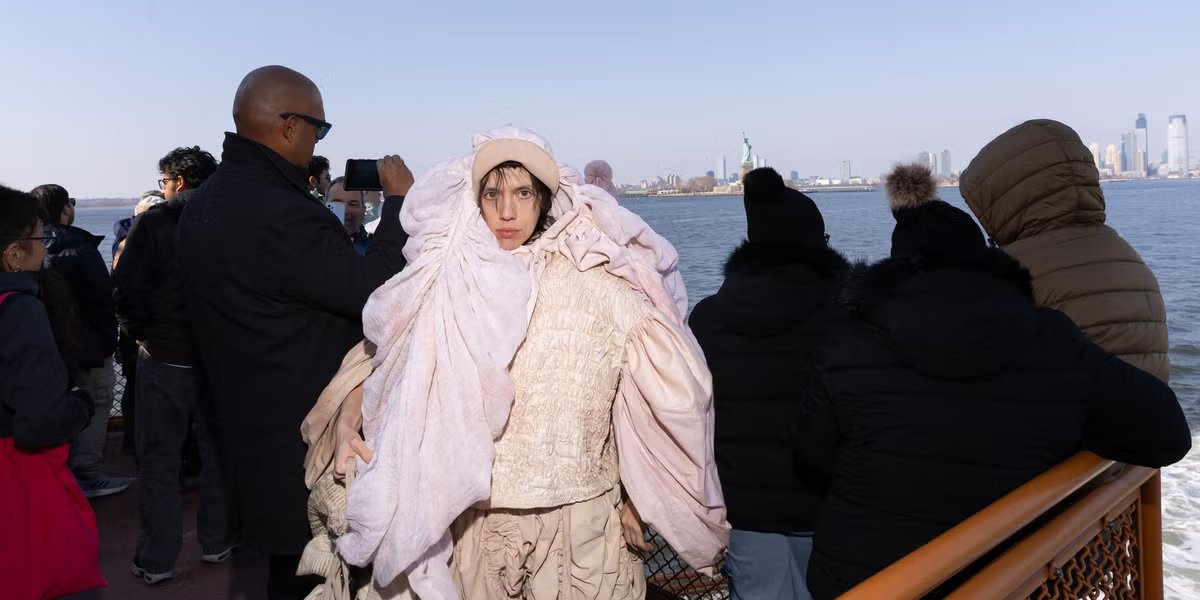
On Saturday afternoon, a crowd gathered at Freshkills Park in Staten Island. It wasn’t a religious gathering, though it certainly had the feel of the spiritual as the artist Camilla Carper walked through the flat fields of the former landfill, outfitted in around 80 pounds of fabric layers that completely enveloped their figure. From the top, there was a square headpiece as big as a bed frame, draped in light strawberry-pink fabric that exposed just enough of Carper’s face. From there, it was impossible to quantify what was what; there was another peach layer and a tawny layer and what were maybe off-white balloon pants. Their body was completely obscured by many layers, which they would remove one by one over the next 45 minutes as they paraded up and down the grass in the manner of a fashion show, while the soundtrack alternated between solemn classical music, recorded audio of different people describing their outfits in that familiar OOTD vocal cadence, and even a snippet of the theme from Curb Your Enthusiasm.
The performance, titled As Possible, marked the end of Carper’s two-year project wherein they aimed to wear as many clothes as possible every single day. It followed a different durational performance where, appropriately, the artist had worn the littlest amount of clothes as possible. Though Carper’s practice takes the form of performance art, clothing is an important aspect of it, functioning as both sculpture and costume—and crucially, they make every garment themselves as the needs or the desire for something new arises. It makes sense; Carper initially studied fashion design at Parsons with the idea of becoming a straightforward fashion designer, but after graduating they found themselves attracted by more conceptual ideas as they related to dressing. Around 2018, they decided they’d make their clothes for one year from a single bolt of fabric and whatever other materials were “presented to” them. It was while Carper was interning for Eckhaus Latta that the idea that they were bound for something different was first proposed to them. “I had a heart-to-heart with Zoe [Latta] about what I was doing, and she was like, ‘I think you’re doing performance art, and you should go to AZ West and figure stuff out,’ ” Carper says. AZ West is the name of the artist Andrea Zittel’s artwork/artist compound in Joshua Tree. Zittel also works with making clothes there, along with other experimental and sustainable modes of living, as part of her artistic practice. Carper lived there for two and a half months “in one of her pods on the side of a mountain,” which helped them focus on what the idea of their own artistic expression could be.

Though the ideas of As Little and As Much initially seemed to be merely mirror versions of each other, the difference in their scope quickly became very evident. “The task of making the smallest garment is a lot easier to achieve than the grandest, the biggest, the heaviest,” Carper explains from their Brooklyn studio. After all, you are working backwards to 0, and once you get there, well, there’s nowhere else to go. As such, As Little Clothing as Possible lasted for a season, from June to September 2024.
They took a short break before embarking on As Much Clothing as Possible in December of that same year. Instantly, it was clear this would be a different kind of experience. Carper’s original plan was to wear As Much as Possible until March, but when the deadline came around, they realized there was another approach to layering the clothes that would make them take even more space. “I made the things to their maximum and then wore them, but I didn’t account for time in the same way. It’s like the project started being less about scale and material and weight, which is what I was mostly focused on,” Carper explains. “What I’ve been trying to [figure out] is how to pack the most material into a form. I wanted my forms to be the most ornate and dense they could be.”

Because Carper was wearing the clothes out in their real life, every day, the project also took on a relational aspect. “I had a scale that had progressive growth from smallest to biggest, but the reality is that it’s more meandering,” they say. “These clothes are also relational to the time and to the environment and the time that I’m living in. I am living and making; it’s not just an idea.” It is one thing to sit down and design and make the biggest clothes you can imagine, but it is quite another to sit down, think objectively about the most space you can take today when that today has rain or snow or you’re in a bad mood or you are in a good mood, and then make those clothes. “We all have imaginary needs, and I don’t totally trust myself with my imaginaries of things, so I look to making clothes to be more of a clarifying process,” Carper says. “I’m looking at the clothes to capture what’s happening in my life—even though there is still this idea of it, like my perception of how much space I will need, whether I am making a bag to carry my laptop or going down on the subway.” As they went out in the world and realized that their garments needed to be adjusted in some way, Carper would remake them with the new specifications rather than alter them. This, in turn, became another idea to explore. In an era where everyone is trying to be a more conscientious, sustainable shopper, the idea of the “ethical” shopper has taken hold: Buy less and only the things that you need, the things that spark joy. A minimalist wardrobe is an enlightened wardrobe.
“I am also interested in setting up these kinds of contradictions,” Carper reveals. “I’m trying to be excessive, but I’m putting my excessive labor into these garments and I’m accumulating at a mass scale; I’m proposing that it is for one body and it is to be worn all at once.” They continue, “I always find that these rules I establish [for myself] tend to mimic some kind of other system that already exists within our economy or within fashion, and I’m always excited about finding those intersections and magnifying one aspect of maybe consumer culture and then pinpointing what it is, that desire and exploring it in a more controlled manner.”
Carper is excited to end a project that grew into something more all-consuming than they initially expected. “Over the course of this project, I feel like I really entered into a space of being in a different dress culture than everyone else,” they explain a few days before the final performance. “Do you know that movie Kate and Leopold? I feel like I’m from a different dimension and I’m inserted into this space where I’m being read as a civilian but no one knows my logic of getting dressed. No one sees me and goes, ‘Oh, that person’s trying to wear as much as they possibly can.’ They’re just like, ‘What’s going on with that person?’ So the performance is also a way of bringing people into my dimension.”
The project has evolved many times over, from surface area to density to volume, which resulted in Carper exploring aspects of historical costume like bustles in order to work on internal structures to hold the weight of the fabric that surrounds them. “I’ve been taking pictures throughout this process, and [from the outside] you can’t see that I’ve changed so much, but there’s a whole system underneath,” Carper says, “and so what’s been interesting is simultaneously making myself hyper-visible to the public, being a character walking around New York, while also experiencing something really private and holding those two things at the same time.”
The experience has changed the way the artist walks through the world, exhausted from being perceived and, surprisingly, since their body is hidden under many, many layers of fabric, of being misgendered. “It’s not surprising, because I am in this ruffly pink shit and I look like a garish, absurd creature, but I am unquestionably gendered as female by most people, whereas I surprisingly wasn’t when I was doing As Little as Possible and was wearing a bikini all summer,” they explain. “I’ve found myself trying to hide in these clothes. I’ve gotten a little bit soft. My eyes are down, I try not to make contact with people, I’ve become kind of closed-off, and I’m also less willing to go places—one, because I know that I’ll have a lot of attention on me, but also because it’s a little harder to get around.” Carper’s physical therapist advised that they should not carry more than 35 pounds of layers in their daily life; they don’t weigh themselves as they leave their house, but they do keep track of how heavy the things they are building and adding to their body are. They’ve found they’ve lost 15 pounds since they started the project. “I’m already small and now I’m like, Oh, I’m getting eaten alive by my clothes!”
When we talk, Carper isn’t sure what their first outfit will be after the project ends. “It’s so much pressure,” they say. “Most of my clothes are in storage, except some things from my own archive I have at home. But I won’t want to wear something that I’ve made before because it’s all loaded with other dressing scores.”
At Freshkills a few days later, the performance would end with Carper and the rest of the participants, wearing pieces from the As Little as Possible experiment, having a dance party. Each one stood in front of one of the artist’s shedded layers, like a ritual burning without the fire. Carper wore a loose, thin, skin-colored unitard, which did little to protect their body from the sudden wind and cold temperature that quickly settled upon the park, but no doubt it also felt a little like freedom.

[ad_2]
Source link