[ad_1]
RSW 145th Open Annual Exhibition, Royal Scottish Academy, Edinburgh ★★★★
James Morrison: In Focus, Scottish Gallery, Edinburgh ★★★★
Rowan Paton: Great Escapes, Scottish Gallery, Edinburgh ★★★★
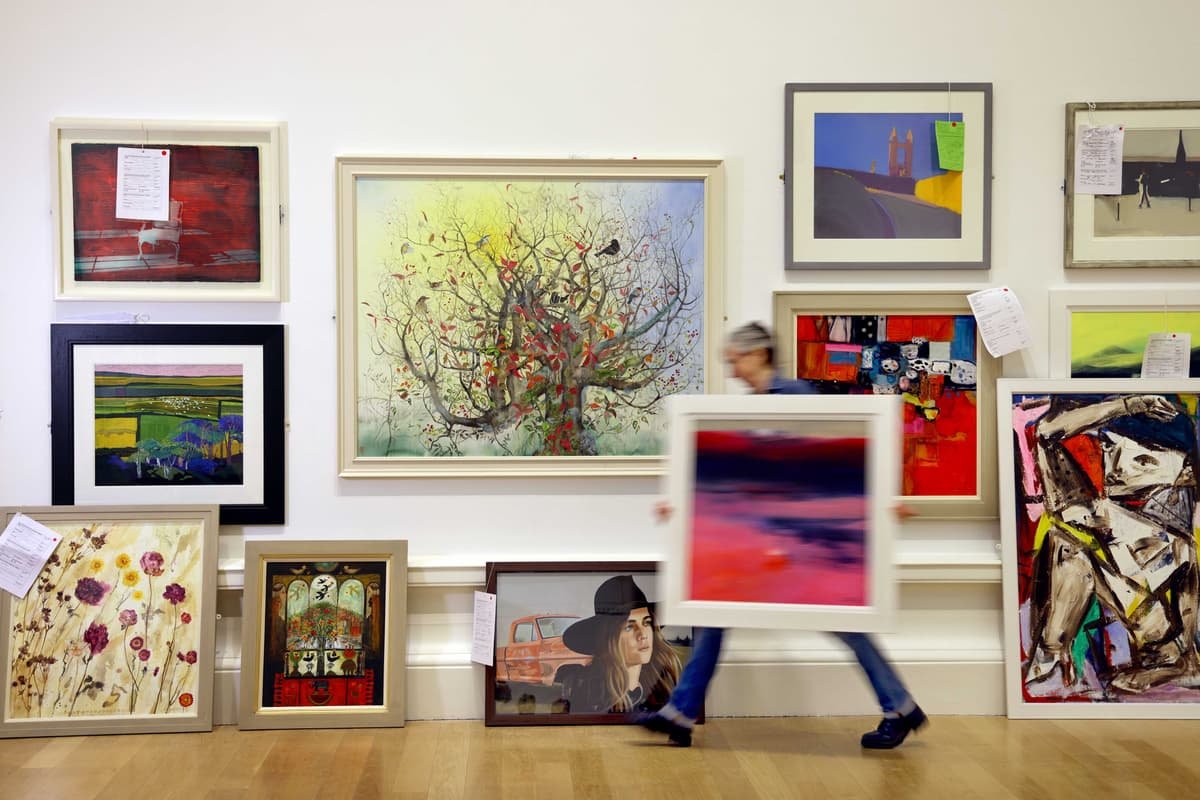
This year is all about the bicentenary of the Royal Scottish Academy, but in two years time it will be the 150th anniversary the RSW – the Royal Scottish Society of Painters in Watercolour – founded in 1878. There has been a bit of slippage, however, so it is its 145th Annual Open Exhibition currently on view in the RSA. In the 19th century watercolour was accommodated in the RSA’s annual shows, held at the time in the eastern half of what is now the National Gallery, but it only had one room. It had become popular, however, not just as a cheaper alternative to oil paint for home decoration, but for its unique qualities of luminosity and transparency. Watercolour painters founded their own society because they wanted more space to show, but they also wanted recognition for their art and its special qualities.


In its partnership with paper, its universal support, watercolour can glow. Nor does it have the materiality of oil paint so it can flow, too, splash even. In the current show we see these qualities brilliantly displayed in Susan Macintosh’s lovely February Love Ascending, a big, vertical, abstract painting in bands of broad washes that seem to express delight in the fluidity of the medium. It is also on a sheet of paper hung without a frame (although with slightly chunky bulldog clips) so we can appreciate how the medium really is paper and paint together. It is not a matter of paint and support as it is with oil paint. Eilbhe Donaldson rejoices in this fact, too, by simply floating two beautiful little transparent vignettes in the middle of her paper.

As you would expect, there are many other works here that seem to express the artist’s delight in these special qualities of watercolour. Alison Dunlop’s Cloud Dance, the Minch, for instance, evokes sea and sky in transparent veils of blue. Peter Davis does something similar in Brim, where you can see how veils of wash on paper become space, but denser paint or just the edges a field of wash can shift the image from space to solid. There is no need for perspective or any other visual mechanism. In Light Passage, Penelope Anstice exploits these qualities to describe a big sky over rocks and water. Meanwhile, in the apparently abstract Everything that was meant to hold, Gemma Petrie not only uses the flow of watercolour, but also exploits to great effect the different patterns of drying that can be achieved by blotting or lifting wet paint. Derek Robertson also does this in In the Compass of the Oceans, but he also sets off the transparency of his medium with a circle of intense, opaque back which seems to be the fierce eye of some mysterious marine creature. Donald Paterson’s The Cuillins at Dusk is a more straightforward moody landscape. The grey transparency of Winter Morning Walk, Arthur’s Seat by Tim Chalk gives the scene a wonderful sense atmosphere while Jacqueline Orr’s freedom of handling suggests the succulence of the fruit in a still-life of cherries.
Hugh Buchanan’s medium has always been watercolour and here he works an intriguing variation on the technique by using corrugated paper. The consequent effect of broken light in Tapestry Chair, Security Camera No. 1, is strange and mysterious and this is even more true of Electric Chair, Red and Green. Nohana Sayama achieves something similar in her mysterious, shadowy interior, The Easter.

Watercolour has always been prized for its delicacy and minuteness as well as its potential for freedom and transparency, particularly in painting the natural world. Sheila Anderson Hardy’s paintings In Half Light and On the Wild Side and Darren Woodhead’s Autumn Tit Flock among Rowan and Viburnum all use it beautifully this way, but do so with no loss of atmosphere. Jonathan Sainsbury’s Rich Decay exploits this quality of the medium in an exquisite study of great tits on the mossy branch of a dead tree.
This versatility has always made watercolour a favoured medium for landscape, for it allows minuteness of description to be allied with luminosity. Neil Macdonald shows this beautifully in his painting of Gardenstown, the little seaside town seen from above and looking along the cliffs. It can equally, though, be the vehicle for beautifully observed still life as in Angus McEwan’s wonderfully cobwebby The Key or the sheer freedom of Lisa Fenton O’Brien’s black trees in a wet landscape, After the Downpour.
But following these reflections on the qualities of watercolour what are we to make of Dominique Cameron’s Hiharin, for instance, or Robert Donald’s Alameda? The first, a wall of solid black squares, seems to be a homage to Malevich or Ad Reinhardt. The second is also just a composition of squares, but on end to make diamonds and coloured. Here we see how the water of watercolour is muddied by acrylic. Also water based, it can mimic the traditional medium so closely that I am not at all sure that all the pictures I have commented on so far are indeed actually watercolour and not acrylic. Where the effect is the same that is really academic anyway, but acrylic can also match the textured solidity of oil paint and that is what we see in these two abstract paintings as well as in other pictures in this show. It is a dilemma I have commented on before but which the society has still not resolved. Unless it does resolve it, its claim to be distinctive does get a little shaky. Still, among all this and so much else – and there are nearly 400 works on view – there could be no better celebration of the wateriness of watercolour than Zifan Sun’s As We Submerge, a painting of two girls in a very watery bath which has aptly won the Dawson Murray Award for the innovative use water based media.

In the context of the above discussion it is amusing to note at the Scottish Gallery how the late James Morrison, although he painted in oil, preferred a smooth gesso ground which allowed him to use it in washes as thin and as freely manipulated as watercolour. The result as we see it here in Angus Winter or Blue Quinag is the airy spaciousness that was typical of his work and does indeed seem to mimic watercolour.

Also at the Scottish Gallery, Rowan Paton’s inventive and colourful paintings are showing under the title Great Escapes. The eponymous picture Great Escapes is typical of her work in that it combines brightly coloured acrylic with collaged elements, in this case cutout snowy mountains. Similar elements are often laid against the texture and colour of unprimed canvas as in Aspidistra, for example, where a collaged jug and a birthday cake sit in an abstract arrangement of fields of colour and bare canvas while the leaves of the plant wander in from the left, their slightly dribbly brushwork contrasting with the neatness of everything else in the composition.
RSW 145th Open Annual Exhibition until 11 March; James Morrison and Rowan Paton until 28 February
The Scotsman’s arts newsletter is now sent twice a week – subscribe today
Want the latest Scottish headlines sent directly to your phone? Sign up to our new WhatsApp channel here
[ad_2]
Source link