[ad_1]
 Listen to this article
At a glance:
- New Rothko Pavilion connects the museum’s two historic buildings
- Rothko paintings, Native works, contemporary Black art on display
- $116M project includes 100,000 square feet of new and renovated space
- Museum will reopen Nov. 20 with public events and free admission
The Portland Art Museum‘s Rothko Pavilion is ready for its public debut after a decade of conception and planning, and nearly three years of construction.
The $116 million project’s centerpiece is the pavilion, a thoroughly modern, four-story glass box that bridges two 20th-century museum buildings.
Perhaps most emblematic of the project: Signs in the museum refer to the Mark building, built in 1970, as the North Wing, while the original Pietro Belluschi museum building, built in 1932, is now the South Wing.
It’s all one Portland Art Museum.
“Connectivity was really the core architectural mission of the project,” said Tim Eddy, principal at Hennebery Eddy Architects. The local firm partnered with Vinci Hamp Architects of Chicago to design the project.
The major design problem was how to combine the two existing buildings. The solution, the architects decided, would be a glazed box. They added two elevators and a central staircase, and several subtle step-downs to help navigate at least 11 grade changes between the Mark and Belluschi buildings.
The result is a landmark civic project for Portland.
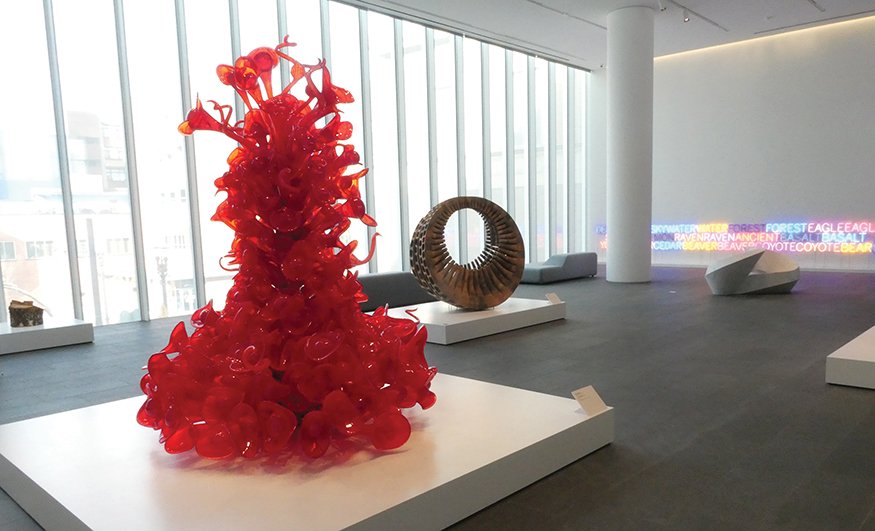
Inside, natural light floods the Rothko Pavilion. Designers used fritted glass to both reduce glare and avoid bird strikes. Heating and cooling run through the floors. Sound deadening was used extensively, and the building has only the quiet hum of the ventilation system bringing in fresh air.
“It was not intended to be a focal third building,” Eddy said. “It was really intended to connect the existing buildings.”
The project adds about 100,000 square feet of new and renovated interior space. Curators have filled that space with new exhibits of Mark Rothko paintings, Pacific Northwest and Native American art, an entire floor dedicated to contemporary Black artists, and a series of immersive digital works.
The connections between buildings should make it easier for visitors to navigate to the various galleries, museum officials and designers said.
“Everyone gets to see more of the art,” said Phillip Hamp, principal at Vinci Hamp Architects.
Outside, a gold-ring sculpture made of gilded timber — “The Sun” by Swiss-American artist Ugo Rondinone — dominates the west side along Southwest 10th Avenue, with views of the West Hills. To the east, visitors can look toward the Hawthorne Bridge and Mount Hood.
The pavilion “creates a new, welcoming central front door to the museum,” said Brian Ferriso, the art museum’s director.
Museum officials raised $116 million for the project itself and $30 million more for an endowment.
Designers took transparency seriously. Pedestrians can look inside the museum, viewing art from a passageway or the sidewalks. Museumgoers can see the city outside the structure.
Outdoor terraces on the fourth floor provide views and resting spots, and space for events. On the ground floor, Providore Fine Foods has opened Coquelico, a café serving sandwiches, salads and pizza.
Vinci Hamp leaned on Hennebery Eddy’s local expertise with Portland’s design review and historic resource processes, Hamp said.
“One of the real benefits of hooking up with Hennebery is they knew this system,” Hamp said. “We had a head start, and they were able to run interference.”
Mortenson served as general contractor, handling unusual materials and a unique project site. KPFF was the structural engineer.
“This vision started over a decade ago and continued through COVID and tariffs and everything else,” said Carolyn Sizemore, Mortenson’s director for the Portland market. “This proves hard, complex things can be completed in Portland — and should be.”
The museum will open to the public on Nov. 20 with a schedule of events and free admission.


[ad_2]
Source link