[ad_1]
Two archetypal executions hover over the Western world’s artistic depictions of the death penalty. The first is that of Sophocles’ Antigone. Sentenced to death for giving her condemned brother’s corpse an honourable burial, Antigone is sealed in a cave but hangs herself to ensure an honourable death. (Though now held up as a great anti-death penalty play, it was nothing of the sort in 441 BC; performances of Greek drama would be preceded by parades of captured war orphans and dead soldiers’ armour.) The second, of course, is that of Jesus Christ. The crucifixion may mark Christ’s passage from humanity to divinity, but it was also a simple application of Roman law; Jesus, after all, was crucified alongside two thieves. Andrea Mantegna’s blunt and forceful Crucifixion of 1456–59, in the collection of the Louvre, captures the dual divine and legal nature of Christ’s execution. He and the two thieves are splayed on the crosses, sinews bulging, and beneath them are not only Mary and John, but also ordinary soldiers gambling with dice.
In Europe during the Middle Ages and early Renaissance, capital punishment was not hidden away in execution chambers. It was a public spectacle, advertised to city-dwellers and featuring carefully stage-managed processions. Gruesome capital punishment, as well as depictions of it in art, had a dual purpose. It not only enforced civic order; it also served to encourage piety and warn against eternal damnation. In a time when kings ruled by divine right, every application of the death penalty was a miniature preview of the Last Judgment.

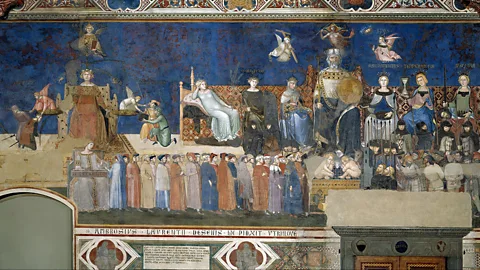
The most honourable means of death was decapitation, as shown in the magnificent Allegory of Good Government, painted in 1339 by the Sienese artist Ambrogio Lorenzetti – wherein Justice sits with a sword in her right hand and a severed head on her knee. Hanging was a less honourable penalty, and beneath that was being broken on the wheel, a horrible punishment that numerous anatomy-curious Renaissance painters would have witnessed. Religious crimes were often punished via burning at the stake; in Francesco Rizi’s 1683 painting at the Prado, Madrid’s Plaza Mayor is filled with thousands of spectators waiting to see the condemned go up in flames. In fact, art itself often played a role in the death penalty. In Italy, a comforter would follow the condemned carrying a tavoletta, or a painted panel of the Passion or the crucifixion, to gaze on in his last moments.
In protest
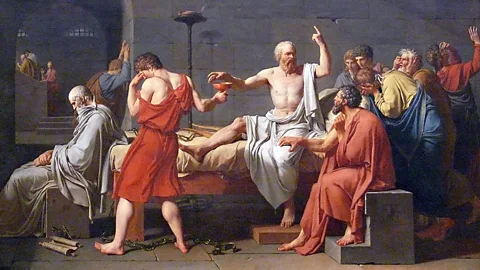
By the 18th Century, capital punishment was still a public spectacle. William Hogarth satirised London’s taste for executions, which took place on public holidays, in his sharp engraving of a lazy apprentice being carted to Tyburn, alongside drunks, hawkers, fighting children and yapping dogs. (On the frame of the image Hogarth included two gibbeted skeletons: a bonus punishment, in which the bodies of the executed were hung on public display.) But in France the more gruesome forms of capital punishment were being phased out, and the country soon instituted a single, putatively egalitarian mode of execution: the guillotine. Jacques-Louis David, who in The Death of Socrates depicted the Greek philosopher’s jury-ordered suicide, also sketched Marie Antoinette on her way to the “national razor”, her face stony, her hands bound behind her. Indeed, David is almost certainly the only artist ever to apply the death penalty. For he was not just a painter; he was a revolutionary and a member of the National Convention, allied with Robespierre. Like most Jacobins, David cast his ballot for the death of Louis XVI in 1792 – and after Thermidor he was lucky to avoid the guillotine himself, ending up in prison in the wake of Robespierre’s fall.
[ad_2]
Source link