[ad_1]
My Experience y La Tuya is artist Arthur Carrillo’s title for his solo October 2025 exhibition at the Jean Deleage Art Gallery in Boyle Heights, Los Angeles, California.This exhibition comes at a historical moment of conflict and tension amongst communities and countries. Carrillo’s photorealism paintings are his visual annotations, noted with brush and paint on canvas of the ordinary turned into exceptional conversations of living energy. Each painting thrives with intricate detail. He maps his local geography and gives special attention to the cultural assets within the Latin@/Chican@, Mexican community. Carrillo chose a bilingual title for his exhibition. He wants to “Reflect the two worlds I culturally inhabit and the overlap between them both.” His paintings celebrate as well as render the fatal absurdity of power as a trophy to subdue the undesired and reward obedient followers of power.
After a long absence from practicing drawing in his teen years, Carrillo decided in 2006 to pursue his inclination in drawing by attending art classes at East Los Angeles College. He would continue his studies at the Art Institute of California-Hollywood, leading to his bachelor’s degree in graphic design. Carrillo has assisted with mural projects and has been the lead scenic artist for many backdrop companies throughout Los Angeles.
With multiple social and cultural connections, Carrillo’s work goes beyond mirroring neighborhoods, people and communities. His work connotes images of our relationship with and in the world. There is an appeal in his paintings for awareness and understanding of ourselves as makers of history that travels between harmony and dissonance. He conveys a triad of raw emotions between his thoughts and feelings as to how we experience one another. The technique in Carillo’s work makes him one of the most talented Mexican American artists today.
Carrillo’s most recent milpa/corn series amplifies the contributions of Las Americas to the culinary wonders across the globe. Mexico is the cradle and the place of origin of corn (elotl in Nahuatl). The engineering of this staple crop 10, 000 years ago from a string of grass is a milestone achievement in human history made possible by Mesoamerican Indigenous agricultural engineers. Mesoamerica agro agro-cultivation derived from a polyculture approach where more than one crop was grown in the same place and at the same time. Carrillo pays homage to this poly-cultivation practice of growing squash (tlalayohtli in nahuatl), beans (etl in Nahuatl) together along the stem of a corn stock in his painting titled ‘Santa Trinidad’ (The Holy Trinidad).
Although this method of poli-cultivation is still in practice, it is minimal compared to the imposition of monocrop cultivation imposed by Europeans upon their arrival to Las Americas. With neoliberal policies of mass agro-industry the sustainability of millennial traditions and alternative methods of farming by campesinos faces opposition and multiple challenges. On March 17, 2025 the ‘Without corn, there is no country,’ campaign achieved a significant development in Mexico’s history and in the world, the implementation of Article 4 of the Mexican Constitution came into effect.
The amendment prohibits the planting of GMO corn seeds throughout its territory and recognizes Mexico as:
The center of origin and diversity of corn, it is an element of national identity, a basic food for the people of Mexico, and the basis of the existence of indigenous and Afro-Mexican peoples.

Santa Trinidad by Arthur Carrillo, 2025.
In the opening chapter, Maíz, Transgenicos y Transnacionales by scientist and journalist Sivila Ribeiro quotes an indigenous Zapotec elder, Aldo Gonzales Rojas:
When corn is planted, four kernels are sown at a time: one is for the wild animals, another is for those who like what belongs to others, another for festive days, and another for family consumption […] Corn is not a business, it is the food that allows survival, that sustains us and brings us joy.
Corn is nowhere to be absent from the Latin@/Chican@ and Mexican lexicon in the States; It is art, culture, food, identity, poetry, fables, myth, celebration, literature and spirit. It is no mistake Jente de Maiz (People of Corn) is a self-reference by those associated with Mesoamerican indigenous roots. Carrillo brings forth our attention to this detail between corn and identity as an act of concientizar. He leaves no vacancy for erasure. Santa Trinidad is Carrillo’s exclamation mark that we are here as a collective body of people rich in particularities with an ancestral continental memory (bio-geographical roots) tied with the land, space and nature. If Mexico were ever to be prohibited from waving its tri-colored flag by any belligerent force (empire) without any doubt in the same way the watermelon is used to represent Palestine, the symbol to fill in that rebellious act by Mexico as its national identity would be the image of a corn.

Tuna, Maiz, y Rabanos by Arthur Carrillo, 2025.
The vitality of Carrillo’s paintings is in the search for truth not by mimicking reality, but what is behind every painted moment and story that has made an impression on him. When his brush meets the canvas the pulse of his work is centered on local stories.
He summons the viewer to feel with every nerve available that painting is another form of writing and writing is another form of painting. There are no cul de sacs in Carrillo’s work. In the process of addressing his locality Carrillo comes closer to knowing his history and that of his community. In an interview with Carillo he expressed his interest, “is not just in communicating some aesthetic pleasure. I want to counter the negative stereotypes of my community with historical and social content.”

Your Excused by Arthur Carrillo, 2025.
A recurring theme Carrillo addresses as a painter is that of the working class Latin@/Chican@, Mexican community. In his paintings titled ‘You Are Excused’ a mason is visualized laying red, white and blue bricks hired to build the country all the while running the risk of deportation.
It is Carrillo’s direct metaphor of a workforce who contribute to the “largest economy in the world which relies on the demographics bonus represented by the Latino community.”
‘You Are Excused’ stands as the most hazy and blurry painting of them all. This ambiguous painting, unlike most of his work in the exhibit, directs us to U.S. instrumentalization/usury ideology embedded in U.S. policies as well as the national psyche towards the immigrant working class. In conversation with Carrillo as to why ‘You Are Excused’ is unfinished, he explained, “The unfinished laborer represents the unseen and the unheard who more than often we don’t care to know about. They are the builders of the country. Made in America is being built by Mexicans and the Latino working class community!”

Bella y Orgullo de Las Americas by Arthur Carrillo, 2025.
According to official data, 2023 remittances from Mexican immigrants sent home to Mexico amount to 63,313 billion dollars surpassing all other national revenues above agro/food and oil exports and dollars generated by foreign tourism.
This demographic bonus adds to the wealth of the U.S and sustains the national economy of Mexico as well as other Latin American countries. Upon experiencing Carrillo’s working-class series many questions arise. Is the Latin@/Chican@ and Mexican working class equivalent to that of other ethnic and Anglo working class groups? Are they singled out as undesirables accused of stealing jobs and a threat to any upward mobility by other working-class minorities? What is the nature of this interstruggle working-class conflict and why?

This Land Was Your Land, But know It Is Mine, It Was Made For Me Only. By Arthur Carrillo, 2017.
Not only is Carrillo’s technique captivating but so is the content of his work. His artwork can also be considered painted Assemblages. The objects in Carillo’ painted assemblages are an extension of his social and political awareness. He does not skip the political aspect of life. It is a constant variable in his visual repertoire.
In ‘This Was Your Land But Know It Is Mines’ Carrillo maps the expansionist spirit and countless doctrines of U.S. history at the expense of someone else’s land and labor. Each object and toy represented in the painting is peeled from its original meaning and gathered to express the subject of war, slavery, lynchings and the fetishism of guns and violence.
Carrillo sheds light on the national isolationist reactions against any competing force that threatens the U.S national identity of superiority and economic monopoly across the world. This masterful theatrical like assemblage work of art, carries volumes of stories of every epoch of U.S. antagonistic colonizing and neocolonial history to this present day. It is an atemporal work of art.

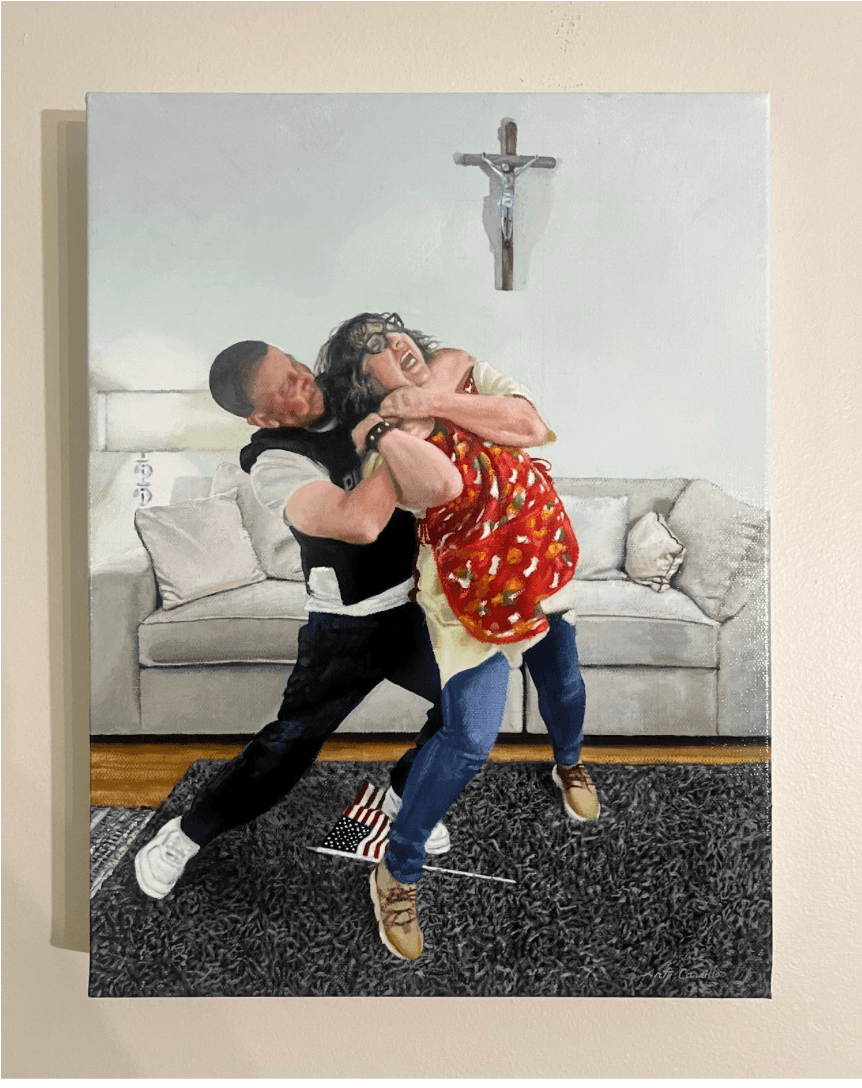
Ice by Arthur Carrillo, 2025.
‘Ice’ is the strongest visual narrative in the exhibition between celebrative images and others with vernacular humor. Carrillo breaks with conformity unwilling to look the other way. Power, violence and all forms and means of domination come together in this one painting. He has no qualms or doubts when addressing hard to swallow issues onto canvas. With this one painting Carrillo expresses the vulnerability of any one person to become an agent of violence subordinated to irrational beliefs and laws that destroy and humiliate communities based on the color of their skin. What ‘Ice’ demonstrates is the surrender of individuals’ capacity to think and question power to a truth established by the core center of power to execute the orders by those in control without any disregard for life. This one painting amplifies hate and fear mixed with lies is the formula best suited for crimes against humanity. And for such crime against humanity to take action a whole series of mass social propaganda along with educational tools must be in place to justify the hideous acts of violence against others. From entertainment to media all participate in propagating a quasi-rational act of violence from genocide to local neighborhood conflicts between individuals. History repeats its horrendous act against humanity by denying the humanity of others. Wars, violence and conflicts are not created in a vacuum much less without first establishing a “distance” between those on this side of the line and those on the other side of the line regardless of their dimension.
For writer and scholar Ngũgĩ wa Thiong’o a work of art comes together when it is shared not when it is finished. My Experience y La Tuya undoubtedly connects us to Ngũgĩ wa Thiong’o and what sociologist Hugo Zemelman once expressed in Pensar y Poder, a critique is not a confrontation but a presentation of the possibilities that are possible. Carrillo’s visual language resuscitates the history of the dispossessed, creates the space to nurture questions and participation and a culture that defies the absurdities and lies of malignant power..
Opening Reception October 18, 2025
Art Exhibit: My Experience Y La Tuya – CASA 0101 Theater
Jimmy Centeno
Curator
www.Casa0101.org
[ad_2]
Source link