[ad_1]
One needs years of immersion in Chinese culture, language, history and philosophy to be able to fully appreciate the timeless beauty and symbolic richness of Chinese ink paintings.
Despite this, everyone can still appreciate the art’s elegant and harmonious forms, be moved by the delicate brushstrokes, and glimpse the universal values that connect across cultures and time.
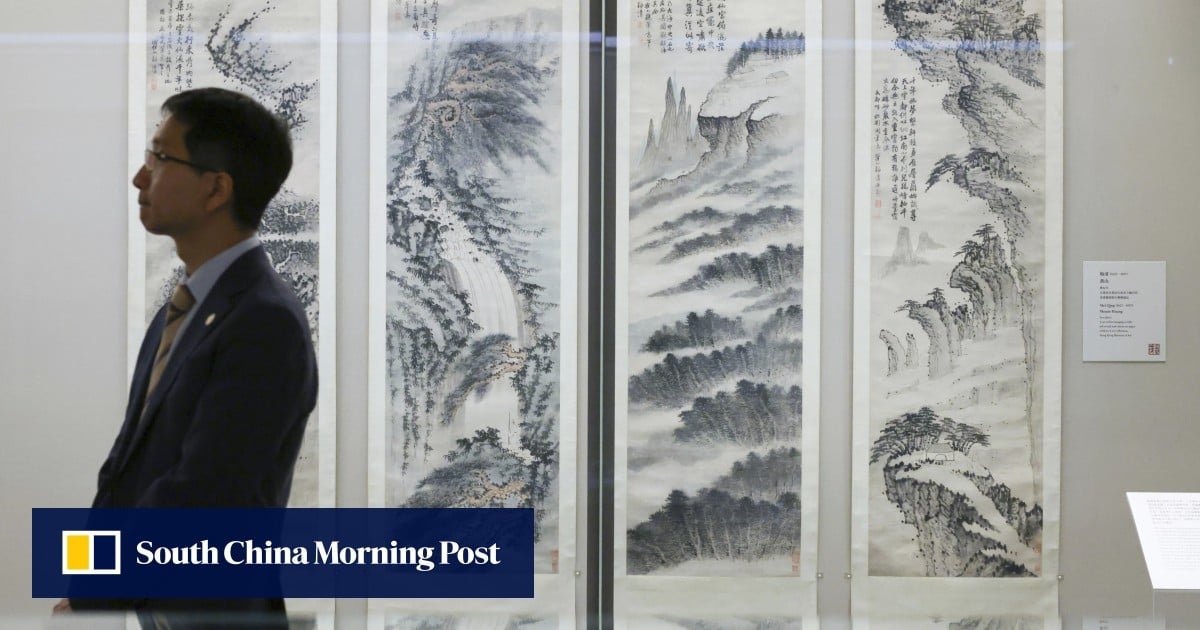
One could do worse than to start with landscape paintings, one of the greatest traditions in Chinese painting, with origins going back to the Tang dynasty (618-907). While people did, of course, paint landscapes before this, it was only after the sixth century that an independent genre appeared.
In Chinese, landscape art is called shanshui, which literally means “mountains and water” – two elements that are in nearly all Chinese landscape paintings.
Landscape art is not just a realistic depiction of nature; it is an illustration of a state of mind and a metaphor for philosophical ideals, such as how mountains and water correspond to yin and yang, a principle of ancient Chinese philosophy.

Before delving into the sophisticated systems of Chinese art, one should start by just looking.
[ad_2]
Source link