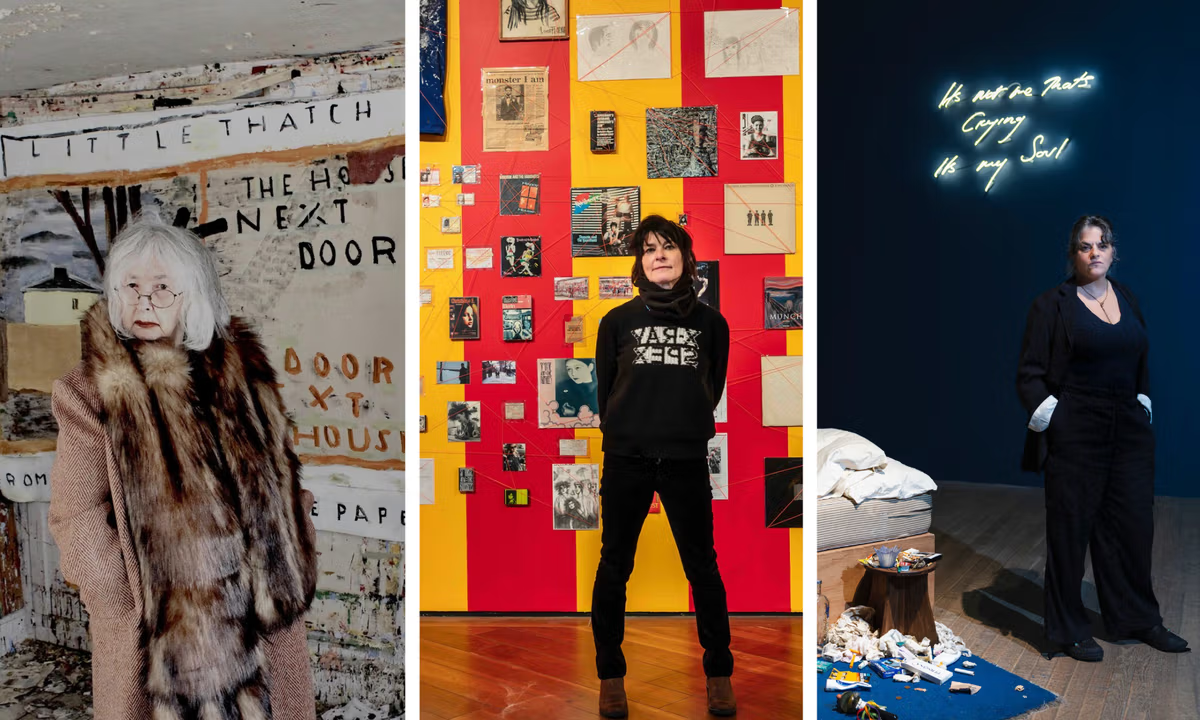
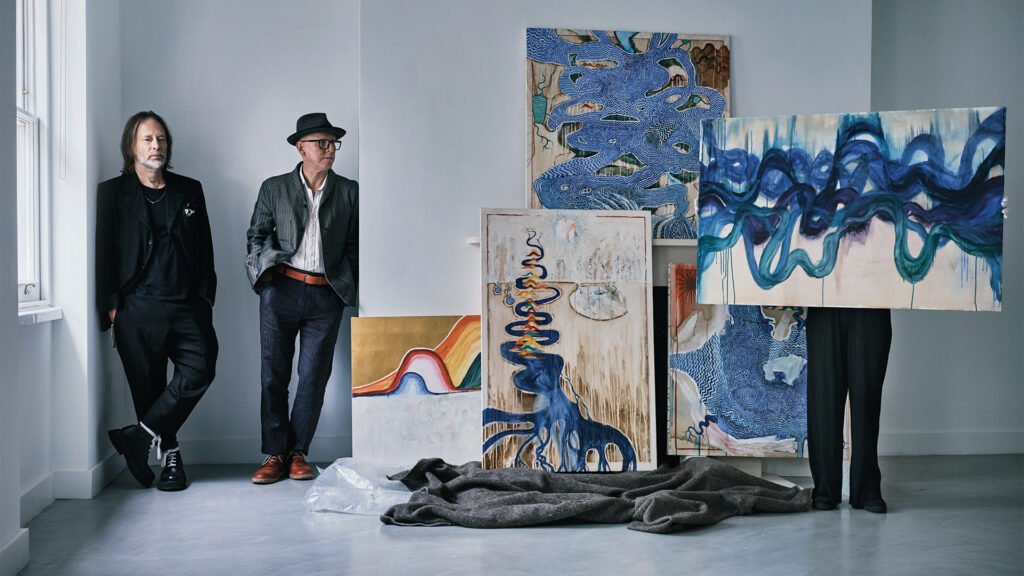
Nearly 40 years later and the pair’s first joint art exhibition, This is What You Get, has just opened at the Ashmolean Museum, Oxford, a 10-minute walk from The Jericho Tavern, the venue where Radiohead played their first gig in 1986.
The exhibition features 180 objects, including original paintings for album covers, digital art, unpublished drawings, as well as original lyrics and sketchbooks. Donwood takes Big Issue behind the creative process of an unparalleled partnership.
Read more:
Big Issue: …so what do you get at the exhibition?
Stanley Donwood: I can’t speak for how anyone else might see it, but for me it’s as if someone has scoured my less-than-perfect memory for a hoard of objects that add up to a highly selective account of what I’ve been doing for the past three decades.
It’s a collection of items that even to me appear quite bizarre; there are paintings and drawings, record sleeves (a lot of those, I admit), sketches, notes, scribbles, doodles and things torn from other things. And there are prints and carved linoleum panels and etched copper plates and t-shirts and postcards and I don’t know what else.
It all seemed to make some sort of sense at the time. I’m hoping that the curators at the Ashmolean have managed to convey a kind of linear narrative out of the massive amount of creative detritus that me and Thom sent them. Let’s hope so, hey?
There’s been over 30 years of collaboration between you and Thom Yorke – what were your first impressions of each other and how did the creative partnership establish and flourish?
I don’t really remember – my memory is less than perfect, as I may have mentioned already. We were both about 20. He was in a few guitar bands, including the one that later renamed itself Radiohead.
I think we may have shared a rather bleak and sarcastic cynicism. As for what you grandly term our “creative partnership”, that sort of evolved from us sharing a very early-model Apple Mac desktop computer in the graphic design department of the art college we went to, and being bad at painting.
How do the music and words of songs influence the art, and vice versa?
This is most definitely a grey area, almost an occult region where nothing is clear or explicable. It may well be that it’s impossible for the making of art to influence the making of music, while for it to happen the other way around is perfectly feasible. Or the opposite. For example:
Nobody likes nothing
I certainly wish with all my heart that it did not exist
But wishing is not enough
We live in the real world where nothing does exist
We cannot just disinvent it
Nothing is not comprehensible
Neither you nor I have any hope of understanding just what it is and what it does
It is hard to know if nothing is actually nothing
And thus difficult to know if a policy of doing nothing is successful
Nothing
However effective it may have proved up to the present
Can hardly continue to do so indefinitely
If I had to choose
Between the continued possibility of nothing happening
And of doing nothing
I would unquestionably choose the latter
Or the former
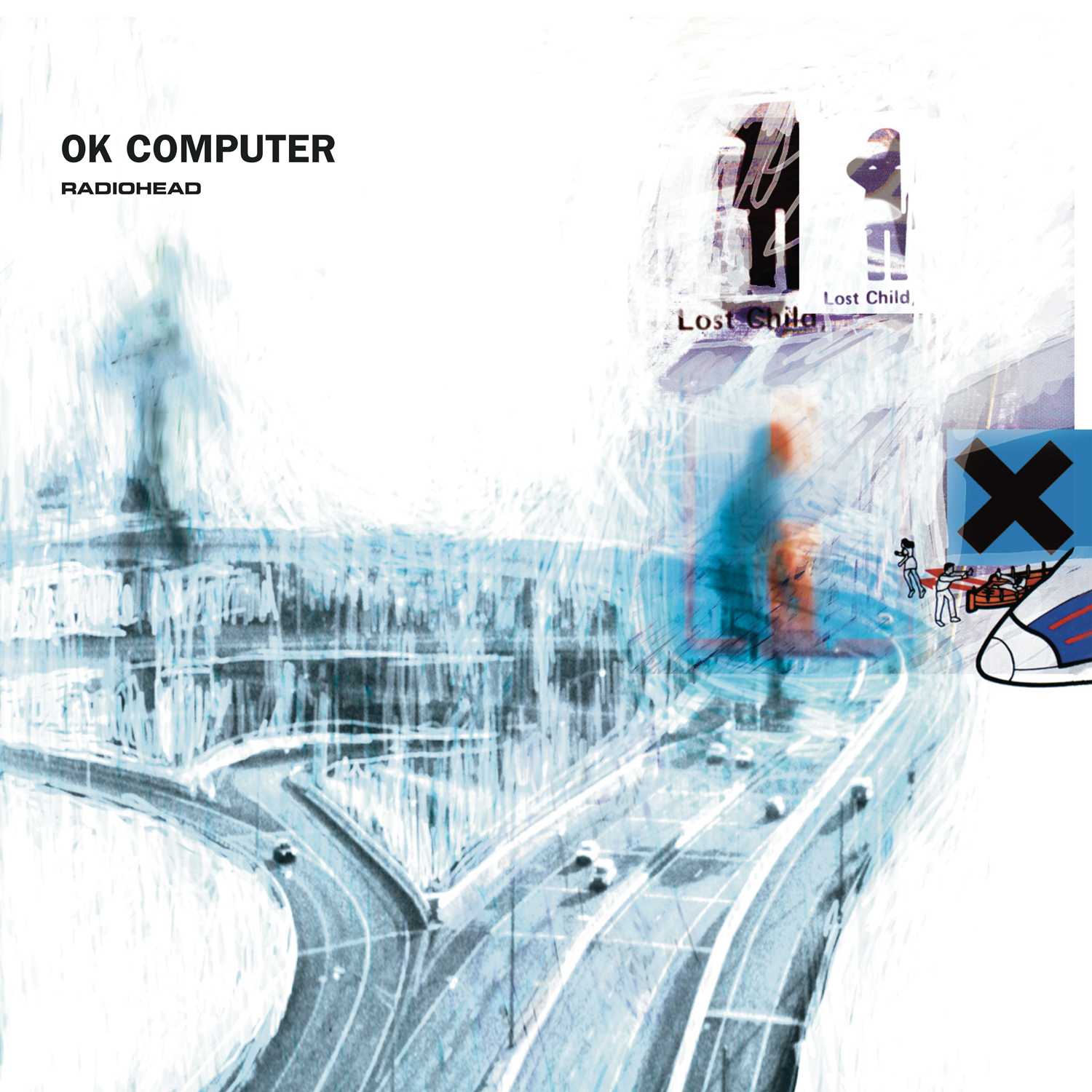
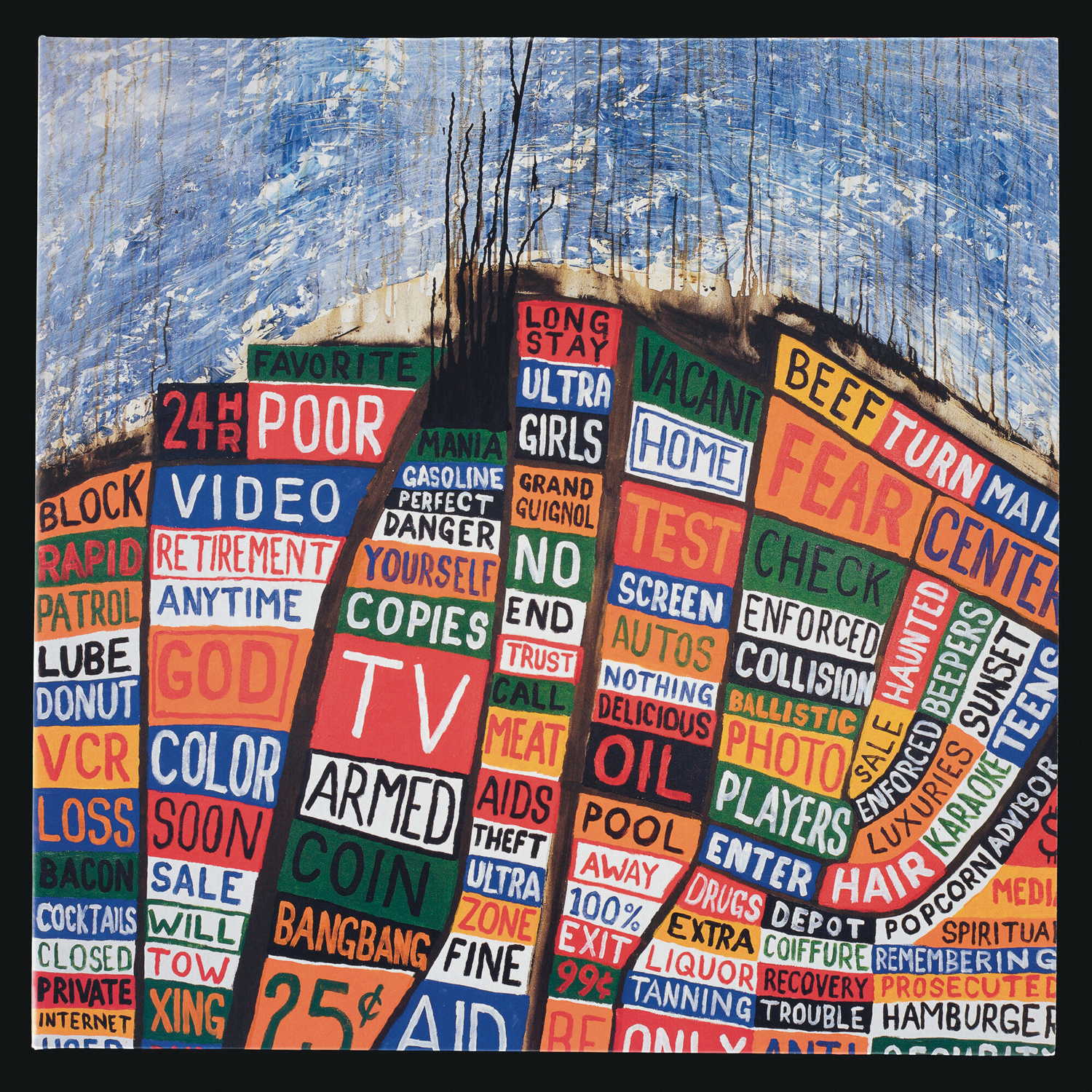
How does the cover of OK Computer anticipate some of the debate around Al and creation that we’re having today – or is art by computer OK?
It doesn’t anticipate AI at all; essentially, it’s a photo of a traffic interchange from a hotel window with some graphics from an airline safety card with various other materials collaged, all made on a computer. Personally, I am bored by computers now, bored of AI. This could well be because I am now a boring person because of my long-held cynical outlook. Is art by computer ok? I don’t know. Probably. Maybe.
Get Out Before Saturday
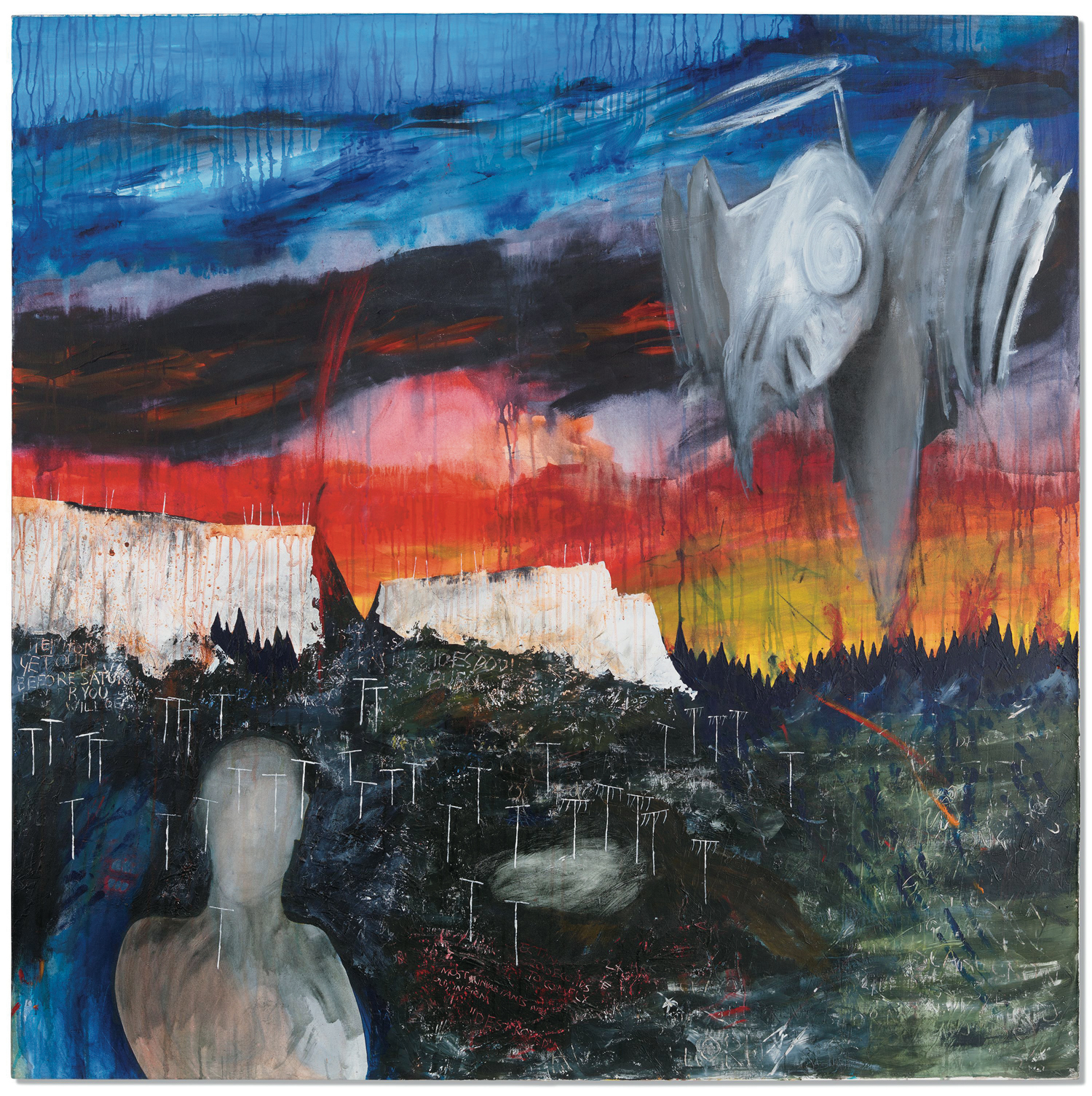
All the work we made for OK Computer was created digitally, using an A5 tablet and a stylus. This is
a pretty boring way to work. You’re always looking at a screen and the drawing is done without looking at what you’re doing, as the tablet and stylus are off to one side and you look straight ahead to a screen to ‘see’ what you’re doing. I found this a bit frustrating.
So after that I got some really big canvases, about six feet square. I bought palette knives and we used those, along with sticks, cloths, shirt sleeves and kicks with boots to make pictures. It was a deliberate attempt to do the opposite of digital art, to use the whole body, not just hand-to-eye coordination. So Get Out Before Saturday is one of these pictures; the title is from something I read about the genocide in Rwanda, a warning given to the people of a village, I think. It’s a very chilling statement.
The painting itself is a sort of compendium of the thoughts I had at the time, thoughts I would rather not have had in my consciousness, but then, what can any of us do about those?
Wall of Eyes

The phrase ‘wall of eyes’ was one that Thom had been deliberating over for several years before we made this picture. It was for the second LP by The Smile, and like the artwork for the first LP, A Light For Attracting Attention, we painted with tempera and gouache paints which was a new medium for us. I showed photos of these paintings to a friend of mine and he said that the paintings for the first record were like maps of how to get to a strange land, and the paintings for the second LP were like pictures of what you would see if you followed the maps. It’s a great description.
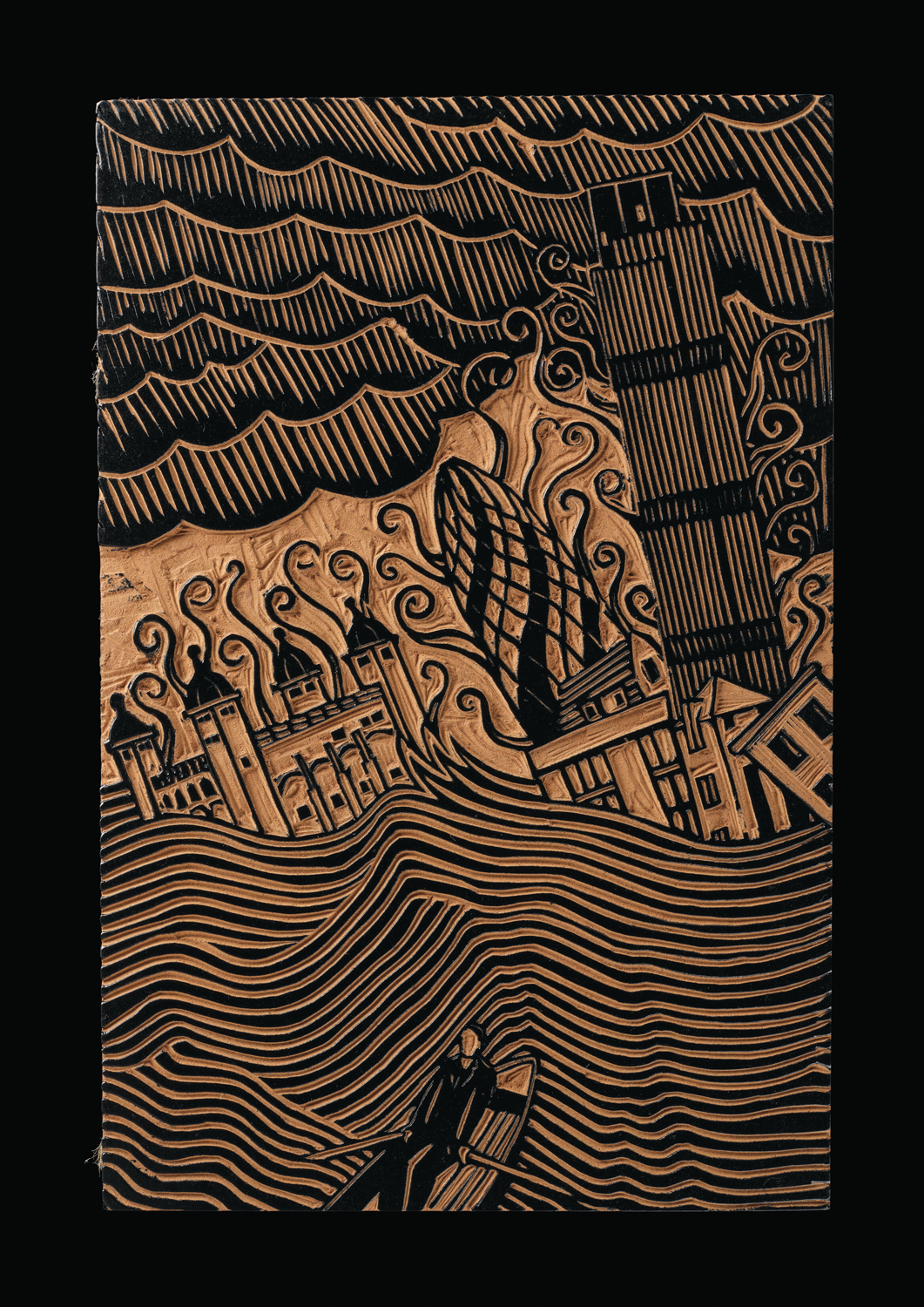
London Views
I had the idea that I would make something like a medieval illuminated manuscript, with gold leaf and coloured artwork. This was beyond my capabilities, so I ended up making a long linocut of London being destroyed by fire and flood in a quasi-medieval style. Luckily that came out OK.
This is What You Get is showing at the Ashmolean Museum in Oxford until 11 January 2026. Standard tickets cost £16.20; or £8.10 for students and under-25s.
Do you have a story to tell or opinions to share about this? Get in touch and tell us more.
It’s helping people with disabilities.
It’s creating safer living conditions for renters.
It’s getting answers for the most vulnerable.
Big Issue brings you trustworthy journalism that drives real change.
If this article gave you something to think about, help us keep doing this work from £5 a month.