
[ad_1]
The Kimbell Art Museum has acquired a rare still life by an artist whose name remains a mystery.
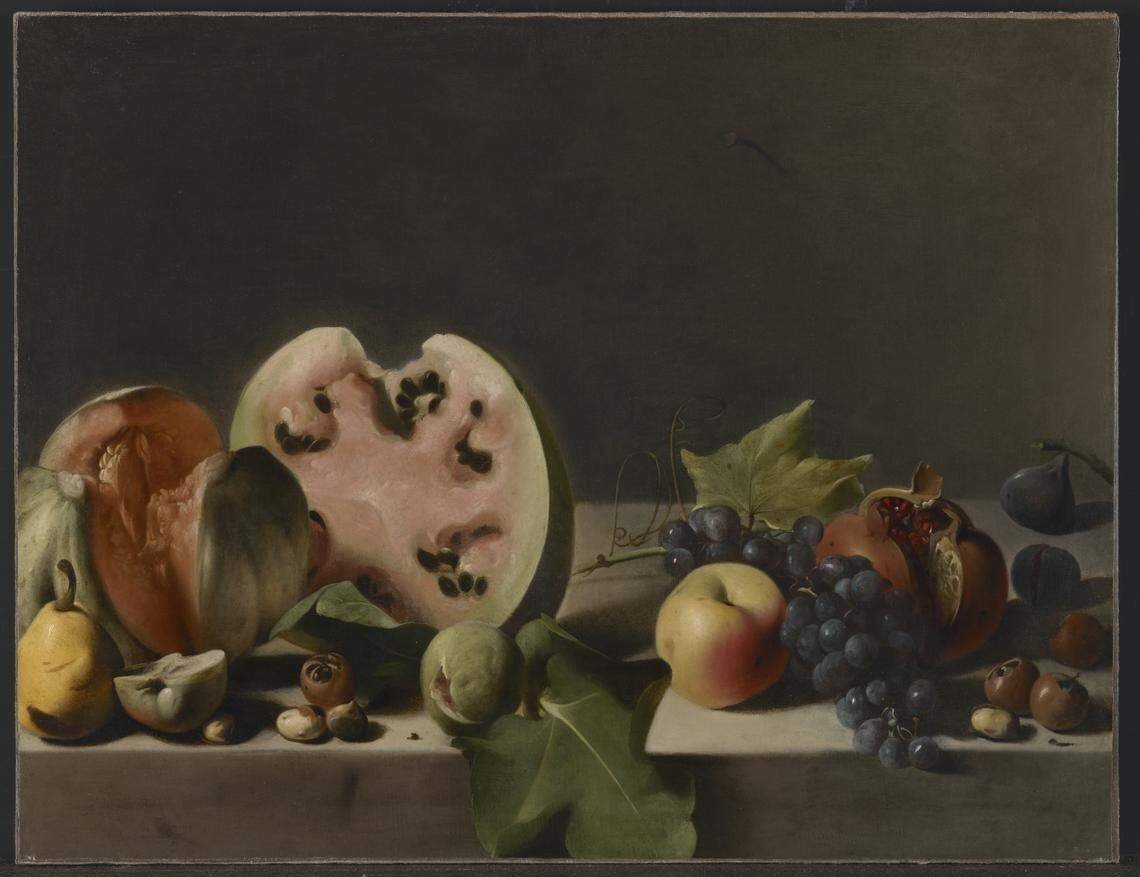
“Still Life with Melon, Watermelon, and Other Fruits” was painted circa 1610–20 by the Italian artist known as “Pensionante del Saraceni,” the name historians give to the unknown artist associated with a small group of paintings created during the same time period in Rome. The reference is to someone who lodged with Carlo Saraceni (1579–1620), a Venetian painter working in Rome, who took in boarders. While believed to be Italian, he may have been French, Netherlandish or Spanish. While his style mimics Saraceni’s paintings, the real influence was the renowned Baroque painter Caravaggio in 1610. That artist’s transformation of painting, with its intense realism, has a lasting influence in the field.
The small, restained painiting is nonetheless an actual feast, with ripe fruits, including sliced watermelon and melon with other fruits such as pears, figs and grapes spread across a tablecloth with leaves folded over and inviting visitors in to partake in the feast. Set against a soft, dark background, Pensionante del Saraceni added a small element that looks like a blotch or a comet. But above the table, in fact, is a nail in the wall. It gives a sense a place, even if unidentifiable, for the fruit.
“The Pensionante del Saraceni is a fascinating and mysterious painter who worked among the Caravaggesque artists in Rome in the decade following Caravaggio’s death in 1610,” said Eric M. Lee, director of the museum. “Still Life with Melon, Watermelon, and Other Fruits is one of the artist’s most important paintings, and it will make a significant contribution to the Kimbell’s small but outstanding collections of still lifes and works influenced by Caravaggio’s distinctive style.
These independent still lifes of inanimate objects were rare for the time, and didn’t really become popular until this period. That makes Pensionante del Saraceni’s even more career defining, and one whose work was emulated and, given the rarity, highly collectible. (It was purchased with the help of New York gallery Nicholas Hall. A price was not disclosed.)
It joins Jacques de Gheyn’s “Vase of Flowers with a Curtain” (1615), Louise Moillon’s “Still Life with Strawberries, Basket of Cherries, and Branch of Gooseberries” (1631), Jean Siméon Chardin’s “The Cut Melon” (1760), Luis Meléndez’s “Still Life with Oranges, Jars, and Boxes of Sweets” (c. 1760–65) and Anne Vallayer-Coster’s “Still Life with Mackerel” (1787).
It is now on display in the Kahn building alongside Caravaggio’s “Cardsharps” (c.1596–97), which just returned from the Palazzo Barberini in Rome as part of the historic exhibition “Caravaggio 2025.”
[ad_2]
Source link