
Not too long ago, there was a time in Armenia’s history where nearly every woman, regardless of age or region, carried the knowledge of fine needlework in her hands. Reaching its peak in the Middle Ages and flourishing through the 19th century, distinct regional schools of embroidery emerged, such as Van-Vaspourakan, Cilicia and Syunik-Artsakh. Each was characterized by unique materials and specific stitching techniques, often named after the region of origin, such as “Van’s thread” or “Aintab’s thread.”
For Armenian women, embroidery was more than just a hobby—it was a rooted tradition reflecting spiritual beliefs, signature styles and an endless variety of patterns. Till this day, to understand Armenian embroidery, one needs to understand the essence of its people, their faith and their story. Even in exile, the stitching of decorative motifs into fabrics traveled across borders, tenderly reinterpreted in distant diasporas to keep the memory of their homeland alive. For these women, embroidery became a way of carrying the nation’s soul in thread and cloth.
A closer look reveals how stylized plant motifs, geometric designs and symbolic figures link Armenian embroidery to broader art forms like rug-making and ceramics. The tradition was sustained through church schools and monasteries, as well as home-based and workshop instruction, ensuring continuity across generations and diaspora communities.
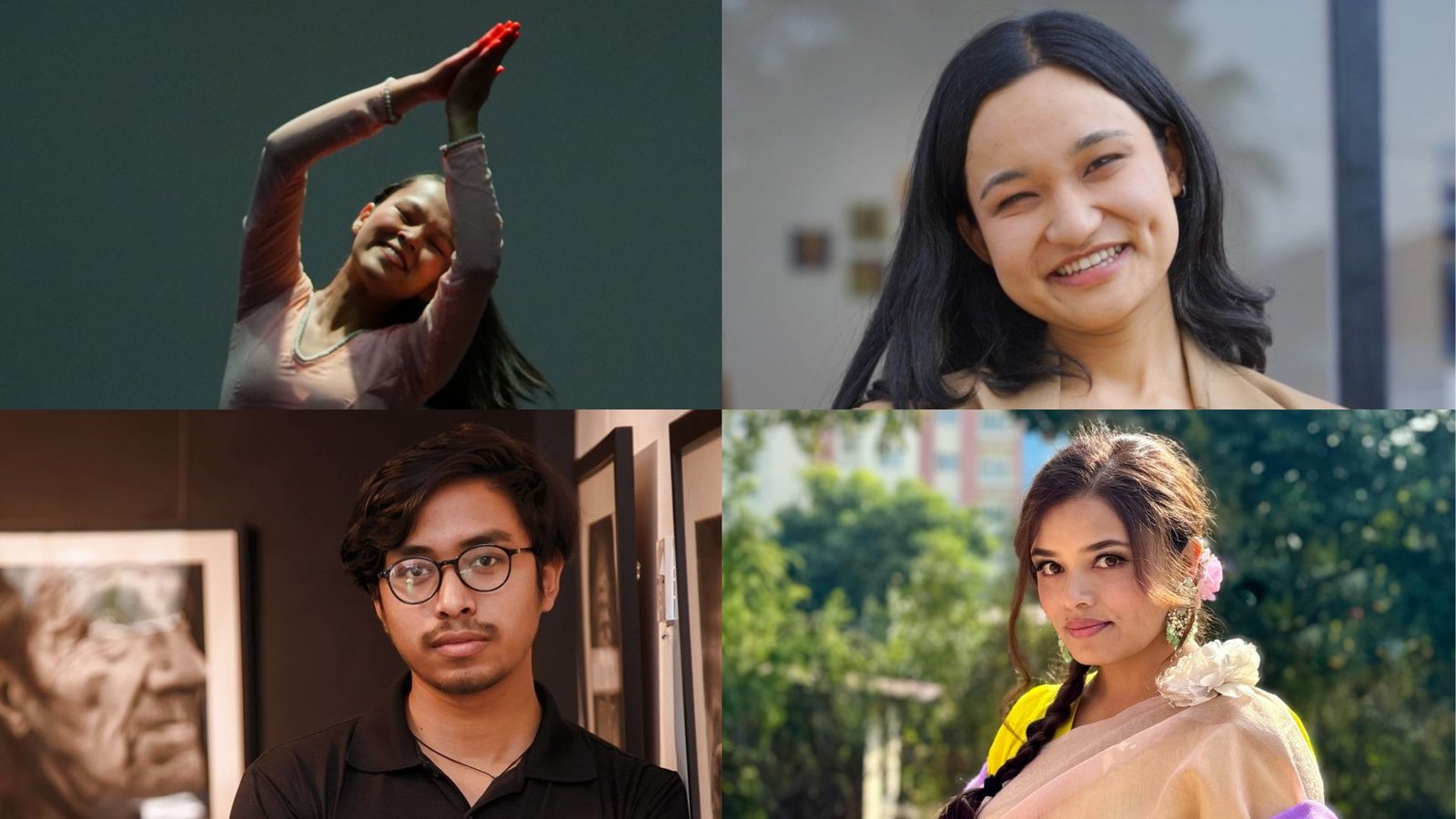
Today, Armenian embroidery serves as a cultural archive, capturing lives, stories and lost homelands in patterns that endure across time and geography. For this article, I spoke with four emerging artists who comprise the new generation working to preserve and promote Armenian embroidery, each with a strong social media presence and dedicated platforms showcasing their work.

Emma Welty Art by Emma Welty
Emma Welty’s journey with Armenian textile-making began as a deeply personal way to reconnect with her family history, particularly after her mother’s passing about a decade ago. Over time, however, this practice evolved into something broader—a way to look forward while paving a path for other artists to access the tools needed to carry these traditions into the future.
Her mother had kept a small collection of heirlooms made by Emma’s great-grandmother: janyak (needlelace), crochet and Aintab lace. A survivor of the Armenian Genocide, her great-grandmother had taught needlework while living in a refugee camp. The delicate, intricate knots of janyak held a special fascination for Emma, but no one in her family knew how to make them. While studying art history, she began researching the tradition, eventually dedicating her master’s thesis to the way janyak made its way into the American diaspora.
Over years, she taught herself through diagrams in books and scholarly articles, Though an imperfect and often challenging process, Emma slowly learned the craft. Even now, she considers herself a beginner, viewing the learning of this art form as a lifelong journey.
“I’ve always shared my artwork online since I was in art school, but it was when I began sharing with teaching in mind that the reach of my work really expanded,” Emma explained.
In 2021, she was finishing graduate school when Armenian Creatives hosted her first online workshop. “It was such a warm group to teach and it is a memory I cherish.” Later, Emma began a remote residency with the Museum of Arts and Design, which opened more opportunities to teach embroidery both online and in person.

“Part of the reason that it took me so long to learn needle lace was that I didn’t know many people who practiced Armenian needlework,” Emma reflected. She has since taught janyak to people of all ages and continually seeks opportunities to collaborate with other practitioners and artists.
Her learning process involved careful study of diagrams found in old needlework glossaries, archival magazines and historical newspaper articles. A key resource was Armenian Needlelace and Embroidery by Alice Odian Kasparian, which she relied on heavily. When she encountered challenges, she turned to the Armenian Museum of America in Watertown, Massachusetts, where she met the late Susan Lind Sinanian, a beloved teacher, dancer and needleworker. Susan offered guidance, shared helpful diagrams and helped her navigate the intricacies of the craft. Emma remains deeply grateful for Susan’s generosity and enduring contribution to the tradition.
Though Emma often uses traditional patterns in her works, she also tries to implement non-traditional colors or applications. In fact, she often finds herself referring to symbols including fruit, mountains and suns, and even uses the lace to spell words, or create a still life. Currently, she is making a series of janyaks using reclaimed fishing line, acknowledging its historical roots in fishing net-making.
One of Emma’s favorite techniques is a strawberry pattern, which she often introduces to beginners because it can be completed relatively quickly. “It’s a playful and soulful little thing,” she noted, reflecting on how food frequently appears in her needlelace work. Recently, she has created images of watermelons, radishes and even tuna cans.
In her practice, food imagery has come to symbolize SWANA futurism—a quiet act of resistance and imagination in the face of blockades and ethnic cleansing.
Besides making people more empathetic consumers, working with a needle and thread allows us to see the human labor in textiles that our society has come to devalue and take for granted, Emma explained. She also believes that any type of hand needlework is a radical act—both for the sake of preserving and sharing cultural memory—and also for the sake of understanding the labor involved in cloth-making and adornment. “Practicing needlework encourages us to mend, up-cycle and reuse cloth that may otherwise end up in a landfill.”

Emma admits that while she and her sister were aware of their Armenian heritage, they didn’t learn the language or many cultural traditions beyond a few family recipes. Discovering traditional needlework techniques became a meaningful way for her to connect with others who generously shared deeper cultural context. In turn, she’s been fortunate to help other individuals reconnect with their Armenian identity through this tangible and expressive craft.
“Any cultural craft or practice—not just stitching—helps us strengthen community and identity. Through my work with Armenian needlework, I have connected with all manner of creative Armenians. My community has taught me more about Armenian language, holiday traditions, mythology, recipes, music, architecture and the list goes on.”
Emma has taught both online and in-person courses in janyak and Marash embroidery, offering classes at local art centers, libraries and museums throughout Connecticut and Rhode Island. Teaching has been especially meaningful to her, as she knows firsthand how challenging it can be to learn these techniques, and she’s committed to making the process more accessible for others. Her primary focus is janyak, which she has learned to execute both left- and right-handed in order to teach it more effectively. She typically begins by showing students how to apply lace to the edge of a cloth, providing a foundation before moving on to freehand janyak with just a needle and thread. Many participants have brought heirloom pieces from their own family collections to workshops, offering a rich and intimate glimpse into ancestral traditions, which she considered one of the biggest privileges of doing what she does.
Armenian Embroidery by Lizzy Vartanian
Lizzy Vartanian’s journey with embroidery began at just five years old, when her Armenian mother first taught her how to stitch. From that moment on, she says that she never put down the needle. While her early embroidery wasn’t strictly traditional, the Armenian influence was there, as her mom would always talk about it, and her great-grandmother’s janyaks were stored at their home.
Growing up in London, Armenian embroidery felt like a private world—one she shared only with her family. But as she got older, her curiosity grew. She began diving into books and zooming in on online images, trying to understand the intricate stitches and symbols of Armenian needlework on her own.

Everything changed when she moved to Armenia. Suddenly, the craft she’d long admired from afar was all around her. “I started visiting places like the Teryan Cultural Center to examine the embroideries up close,” Lizzy explained. “Museums here also have incredible examples on display; it’s been so inspiring to see them in person.”
Inspired by this deeper connection, in 2019, Lizzy began sharing her own embroidery work online. Then, in 2024, she launched the Instagram account ArmenianEmbroidery. “Living most of my life in the UK, I realized no one around me even knew Armenian embroidery existed. I kept seeing other cultures celebrate and showcase their embroidery online and thought, why isn’t someone doing this for Armenian embroidery?”
She made it her mission to change that. Over the past six months, Lizzy’s account has been steadily gaining followers. Through Instagram Reels and thoughtful posts, she educates people on the rich variety, meanings and history behind Armenian embroidery. To her, it’s not just a craft; it’s a way of preserving and sharing culture, one stitch at a time.
Not limiting herself to only classics, Lizzy blends traditional patterns with contemporary artistic expression. For instance, she recently recreated a shirt from the Alyour village near Van as a tablecloth in super bright colors, which are not traditional at all.
“In some of my personal works, I turn old family photographs into embroideries. Recently, I’ve been stitching Armenian embroidery styles like Marash and Svaz on top of old black and white family photographs from Beirut. I’ve also been stitching images from old Armenian church manuscripts.”

Upon her move, she reached out to Maral Sheuhmelian, an incredibly talented embroiderer and entrepreneur originally from Aleppo—who, like Lizzy, is also Aintabtsi. “I asked if she would teach me,” Lizzy recalled. “She’s amazing.” That experience deepened her belief that learning from our elders is vital. This is how our traditions stay alive.
As many traditional Armenian embroidery styles are named after places in historical Western Armenia, Lizzy believes that link to geography, family and memory gives the craft a profound emotional resonance. “Embroidery takes time. It’s physical and it’s personal. When I make something for someone, it’s usually because I really care about them. It’s a labor of love.” The two embroidery styles that have a special place in Lizzy’s heart are Aintab, because it ties directly to her family roots, and Urfa, simply because its aesthetic feels most like her own personal style.
For members of the diaspora, Lizzy believes Armenian embroidery offers a powerful way to reconnect with their heritage. “When diasporans learn these techniques, they feel closer to their ancestors. At my workshops in London, it’s not just about stitching—it becomes a space for community, storytelling and shared identity.”
More than an art form, Armenian embroidery is a language of its own. “The symbols have meanings; they tell stories. And for those of us who aren’t fluent in Armenian, learning embroidery is a kind of alternative language. It’s another way to communicate, to carry our culture forward.”

Whether in Yerevan or London, Lizzy always begins her embroidery workshops with the basics, grounding her students in the rich history of Armenian embroidery. She introduces where each technique comes from, explains the meaning behind traditional motifs and only then moves into the stitching itself. “Understanding the story behind the stitches makes the craft feel so much more meaningful,” she explained.
Recognizing how difficult it can be to access resources on Armenian embroidery outside of Armenia, Lizzy also created a series of embroidery kits that comes with a detailed history booklet, all made in Armenia and available worldwide. “When I was living in London, I wished something like this existed, so I decided to make it myself,” she shared.
Shogher Embroidery by Araks Mirzoyan
Araks Mirzoyan first encountered Armenian embroidery in 2019 as a third-year journalism student at Artsakh State University. At the time, the idea of embroidery becoming her main profession seemed unlikely. She started small and personal, with simple designs stitched onto her own clothes and those of her family.
Once she’d embroidered nearly everything in her family’s wardrobes, she began creating pieces for friends, giving them as heartfelt gifts. She occasionally posted photos of her work on her personal social media accounts, and quickly noticed how much interest there was in handmade embroidery. That growing enthusiasm inspired her to launch a dedicated page to showcase her creations. She named it Shogher and, over the years, the platform has steadily grown; what began as a passion project has since evolved into a brand.

Through studying old embroidery traditions, Araks discovered just how intricate, symbolic and meaningful Armenian patterns are. Yet, even when trying to replicate traditional designs, each piece still comes out uniquely, shaped by the hands, threads and fabrics of today. “That’s the magic of handmade work,” she explained. “The same pattern becomes something entirely different in different hands.”
Araks is especially interested in blending old with new, taking traditional motifs like Marash embroidery and combining them with modern techniques and materials. Her goal is to honor the past while keeping the art form alive and relevant in the present.
Growing up, Araks shared that she didn’t see embroidery being practiced at home, as her mother and grandmother worked more with threads, but not in the traditional embroidery sense. So, she taught herself, thread by thread, stitch by stitch. Still, she’s deeply aware of the long-standing Armenian tradition in which embroidery was an essential skill passed down through generations. “In the past, every girl had to learn to embroider,” she noted. “They learned from their mothers and grandmothers—who certainly knew how to do it—and even in girls’ schools, different types of needlework were taught as part of the curriculum.”
When she first picked up a needle, she was eager to explore every corner of Armenian embroidery. Over the years, she’s learned techniques from different masters, studying Urfa, Van and Kughakar embroidery styles, as well as the lacework of Van embroidery. “Each one is completely unique and inimitable,” she stated. “They all have their own story, their own character.”
But the closest to her heart is the Marash embroidery, as she sees parallels more in historical realities.
“I teach Marash embroidery, and we know that the city of Marash was depopulated as a result of the Armenian Genocide, unfortunately. My childhood and youth were spent in Artsakh, and unfortunately, Artsakh too is now depopulated. Every time I teach embroidery, I also present a small historical overview to my students, so that they know how valuable what they are learning is.”
To her, Armenian embroidery is much more than just a craft—it’s a cultural treasure, rich with meaning and significance. “You can learn so much about people through their embroidery,” she reflected. “Artistically, it’s unmatched. There’s so much room for creativity. And emotionally… Well, I’ve been immersed in Armenian embroidery for six years now, and I’m still just as in love with it as when I began.”

It’s been six months since Araks launched her online course in Marash embroidery, and the response has been inspiring. Participants have joined not only from Armenia, but also from places as far as Georgia, France, Canada, Finland and the United States. “It’s been amazing to see such dedication from young girls and women of all ages,” she shared. “Their enthusiasm for learning and preserving our national craft is truly heartening.”
The course, which runs in small groups over one and a half months, has proven to be highly effective, especially for Armenians in the diaspora who might not otherwise have access to this kind of learning. Thanks to the online format, more people than ever are able to reconnect with their roots, no matter where they are in the world. Araks is no stranger to teaching, as she’s led numerous courses over the years, for both adults and children, including three years as a needlework instructor at an art school. Creating a fully online course took nearly a year of planning and development, but it’s a dream she’s proud to have brought to life. The next course is set to begin in June, and updates will be shared regularly on her Instagram page.
For Araks, embroidery isn’t just about technique—it’s about cultural identity. “In today’s world of fast fashion and trends, many cultures are losing their national identity,” she explained. “But embroidery can help us preserve what makes us distinct. If we can recognize the value of our traditions and share them with the world, they will continue to thrive.”
Entangled Roots Press by Ali
Ali’s journey with embroidery began during the early stages of the pandemic lockdown, when she was invited by a close friend to join an online janyak embroidery class. This class was taught by Emma Welty and hosted by Armenian Creatives. Having never embroidered before, she initially struggled with the craft and dismissed her difficulty by assuming it simply wasn’t part of her lineage.
It wasn’t until over a year later, when a Palestinian friend invited her to co-host a monthly SWANA stitching circle, that she returned to the practice. Around that same time, her mother gave her pieces made by her great-grandmother—proof that the tradition did, in fact, run in her family. Still, it was the shared space of the SWANA stitch circle, the community it fostered and the knowledge exchanged there that truly inspired her to explore the art of hand embroidery more deeply. “Printmaking is my main craft, and I began combining prints with janyak, and sharing that work. Much of my printwork encompasses themes of cultural reclamation and remembrance. Janyak is a piece of that thread,” Ali explained.
She credits much of her understanding of traditional janyak motifs and patterns to Alice Kasparian’s book Armenian Needlelace and Embroidery, where many designs have been carefully cataloged and preserved. Drawing from materials already in her studio, she began experimenting with waxed linen thread, originally used for bookbinding, infusing the tradition with new color palettes and forms. This process allowed her to reinterpret the craft through a personal and contemporary lens. Eventually, she began incorporating janyak into the edges of screen-printed banners that share hope and justice as a message, as a blessing.

For Ali, the Arshaluys motif is a personal favorite. “It resonates as I piece together and work towards being a piece of that light which shines on our collective stories; past, present and future. I think of it as a symbol of utopia, that which we continue to fight for and struggle towards.”
Beyond the initial class, most of her learning has come from books. One of the most influential was Armenian Needlelace and Embroidery, a gift from her aunt—along with others she has collected or received over time. In addition to books, she’s had the privilege of conducting her own research, drawing knowledge from museums and cultural stewards within both the diaspora and the homeland.
“We are blessed by the diversity and richness of a heritage passed on by 30 centuries of diligent practice, yet burdened by the pressure to keep alive a tradition nearly destroyed by the Genocide.”
She shared how hard it is to express the importance of Armenian embroidery, but with the same intention that Alice Kasparian documented the Armenian people’s needlework,
Ali’s practice is also a tribute to the millions of artisans and craft-workers who—throughout the country’s long subjugation—lost their heirlooms, their connection to their craft and their lives.
Ali recently taught her first janyak class through their SWANA Stitch Workshop series, which was sold out. Ali had also taught other Armenians in her community in Portland one-on-one how to create janyak. She recalled giving a brief lecture on the craft where she had illustrated, written and then screen-printed onto cotton handkerchiefs as handouts. Participants were then invited to create their own needle lace along the edges. “The support and encouragement I received has kindled my desire to continue to pass on this craft to others,” she explained.

Still, for Ali, embroidery is not simply a practice of preservation, but a radical act—an excavation that traces ancestral roots, lands and histories, uncovering the paths that have shaped each individual’s journey to the present. “We are keeping our traditions alive, not as they were, but as they are now,” she explained.
In terms of physical practice, she believes stitching can truly ground us. It soothes one’s nervous system. When people gather to stitch, they talk and share and learn together. It does not isolate, but creates a sense of community, which, in turn, gives people strength. “Our stitches are bridges between each other, between lands, between times. More than simply learning the craft, it opens up questions and the search for answers brings us to delving deeper into ourselves and towards each other,” Ali expressed.
“I have learned these lessons first and foremost from the Palestinian Tatreez artists who continue to keep their cultural identity alive in spite of an ongoing genocide, cultural erasure and appropriation. Our needlework is but another root that stretches back across borders and time,” she explained.
“Stitch by stitch, we are finding each other and ourselves.”

Hena Aposhian is a freelance journalist who primarily focuses on Armenian arts & culture. She is a graduate of the American University of Armenia and holds a bachelor’s degree in English & Communications.